
Name the principal.
Who the agent acts for, and who delegated it.
Agent trust · In development
An agent can act quickly. Its authority should be just as clear: who it represents, what it may do, and when a person needs to approve.
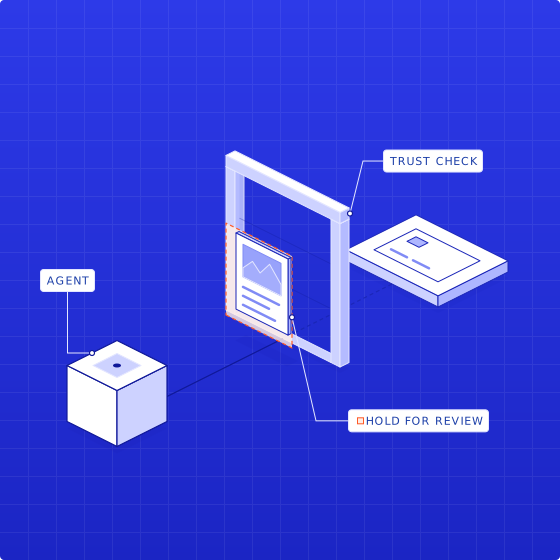
The model
Who the agent acts for, and who delegated it.
What it may do, on what. Requesting a refund is not issuing one.
Amounts, expiry, and when a person must approve.
What was asked, what was allowed, what was done.
A concrete example
Consider a support agent with permission to execute refunds up to $200 while its delegation remains valid.
| Request | Delegation | Policy outcome |
|---|---|---|
| Refund $80 | Valid | Within the amount limit; other business checks still apply. |
| Refund $800 | Valid | Requires additional approval. |
| Refund $80 | Expired | Cannot proceed under this delegation. |
Our focus
Agent trust is in development. We start with one consequential action and the identity and policy systems you already run.
Read our approachCommon questions
No. Recognizing automated behavior does not establish who delegated an action or whether the requested action is permitted.
No. Identity and authorization answer different questions. The action still needs to fit the relevant scope, constraints, and current policy.
When an agent uses submitted material to propose an action, the workflow may need both a review of the evidence and a check of the agent’s authority.
Agent trust
Bring your agent workflow and the boundaries it needs to respect.
Book a demoSee it on your own file.
Book a demo