
A submitted bank statement can influence a lending decision long before anyone establishes what it proves. A readable file may contain altered figures. An authentic statement may show funds that do not qualify for the loan. Reviewers need to keep those questions separate. Each claim needs appropriate evidence, with a clear owner for unresolved discrepancies.
Separate the claims behind a bank statement
Bank statement verification is the process of assessing a statement's authenticity and corroborating the financial information needed for a decision. The scope matters: confirming an account balance does not establish income, and finding no signs of document manipulation does not confirm either.
At Trustable, we check bank statements for suspected edits and AI generation, showing where each finding appears and how strong the signal is. That authenticity layer fits at intake, before an underwriter relies on a submitted statement. Account ownership, balances, transactions, qualifying income and source of funds require separate evidence alongside that review.
A useful review distinguishes the claims behind the request:
| Review question | Evidence that addresses it | Boundary |
|---|---|---|
| Is the uploaded file authentic? | File-forensics findings, an issuer-supported verification mechanism or an independently obtained issuer copy | No detected manipulation is not proof of authenticity |
| Does the account belong to the applicant? | Account-holder information from an authorized bank source, matched to the verified applicant | A name printed on an uploaded page or access to an account is insufficient on its own |
| Is the stated balance supported? | A bank-sourced balance for the relevant account, date and balance type | A historical closing balance does not establish today's available funds |
| Did the listed transactions occur? | Bank-sourced transaction records covering the same account and period | Correct arithmetic inside the PDF does not confirm the transactions |
| Do deposits support qualifying income? | Income evidence and the lending program's assessment rules | Total credits include transfers, refunds and other receipts that may not be income |
| Are funds from an acceptable source? | Records connecting the relevant deposit to its origin, assessed under the applicable policy | A bank-confirmed credit does not establish its ultimate source or acceptability |
Keep a separate result for each required claim. A single “verified” label hides evidence gaps that the underwriter still needs to resolve.
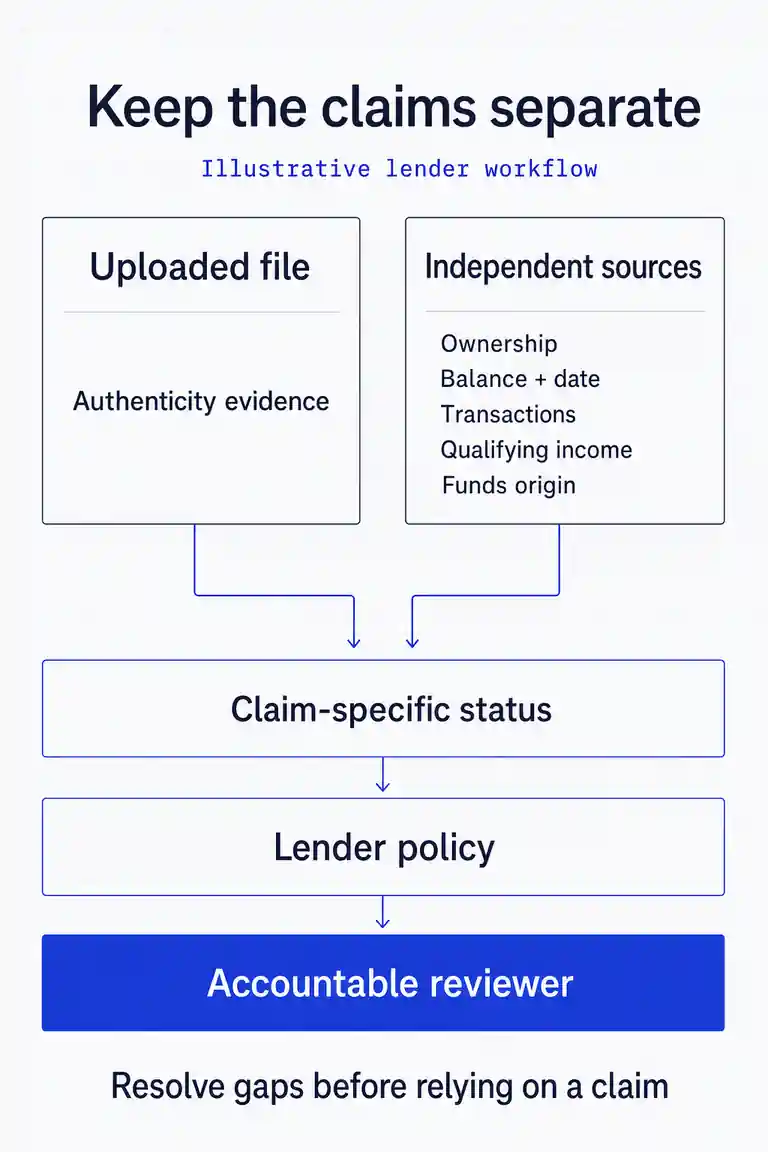
The lender workflow, from upload to decision
1. Define the decision and evidence requirements
The lending program determines the required accounts, statement periods, document age and acceptable verification methods. A review of funds for closing has a different purpose from an income assessment or investigation of a particular deposit.
Fannie Mae's asset documentation requirements illustrate that specificity: statement coverage varies by transaction type, and required information includes the institution, account holder, account identifier, covered period, activity and ending balance. Those requirements apply to that mortgage program; they are not a universal checklist for every lender.
The request should name the evidence needed and the secure submission route. Any bank-data access uses appropriate applicant authorization and the lender's approved connection or request process. Reviewers never collect banking passwords or one-time security codes through email or chat. Those credentials do not belong in a case note either.
Sensitive financial records belong in a controlled case system. Access and retention follow the lender's policy, and follow-up requests stay limited to the information needed for the decision.
2. Preserve the upload and establish completeness
The preferred submission is the issuer's downloadable statement with every required page. The intake record identifies the original file, submission time, applicant and claimed source. A file hash can tie later findings to the exact bytes reviewed, an integrity control described in the National Institute of Standards and Technology's digital evidence guidance. It does not establish who issued those bytes. Converted files and extracted data remain linked to the original rather than replacing it.
The processor establishes whether the submission is usable:
- All expected pages and required periods are present, including transaction pages.
- The institution, account holder, account identifier and currency are legible and consistent across the packet.
- Statement dates cover the requested period without unexplained gaps or duplicated months.
- Redactions or cropping have not removed information needed for the assessment.
A balance screenshot or partial transaction export may answer a narrower question than a full statement. Its acceptance depends on the program's evidence requirements. Missing pages and unreadable fields are collection problems first, not findings of fraud.
3. Assess file authenticity before relying on the figures
Authenticity review asks whether the uploaded file shows evidence of alteration or fabrication. Our guide to spotting fake bank statements covers page-level and file-level warning signs. The verification workflow records what was observed, where it appears and what evidence could resolve it.
Trustable's localized findings help a reviewer identify the field or region requiring attention. A signal's strength is not a calibrated probability of applicant fraud, overall model accuracy, ground truth or proof of intent. Legitimate scanning, conversion or re-saving can change a file; a polished statement with no detected manipulation still needs appropriate corroboration.
Where the issuer provides a document-verification service or digitally signed statement, the approved workflow can add issuer evidence. A visible signature or stamp is different from a validated digital signature. A link or QR code printed on an untrusted upload does not establish a trusted bank channel on its own.
An inconclusive finding remains an evidence gap. The same applies when an input is unsupported or analysis fails. A result never becomes favorable merely because no usable finding was returned.
4. Reconcile the statement's internal data
The next review asks whether the document is internally consistent. Extraction software can turn statement content into structured fields and transactions; the processor resolves uncertain readings against the source page before treating them as discrepancies.
For a depository statement, the basic relationship is:
Opening balance + posted credits − posted debits = closing balance.
The calculation includes fees and interest according to the statement's presentation, without counting them twice. Running balances, where shown, should reconcile with the listed activity. Across consecutive statements for the same account, the previous closing balance should agree with the next opening balance.
An arithmetic mismatch can come from a missing page, a misread amount, a duplicate extracted row or a changed figure. The case record identifies the exact difference and its source before assigning a cause.
This is statement reconciliation. Transaction analysis goes further, classifying activity and assessing cash flow or income patterns. It can also examine debt payments. A file-authenticity finding does not establish those financial conclusions. A statement that adds up can still contain invented transactions, so internal consistency and independent corroboration remain separate results.
5. Corroborate the financial claims through an independent source
A fresh applicant-uploaded copy may improve file quality, but it is still supplied by the applicant. Independent corroboration uses an authorized bank-data connection or a direct institution response. Another independently obtained source may be appropriate to the claim.
For example, Fannie Mae permits authorized third-party asset verification and requires its Verification of Deposit response to come directly from the depository institution. The lender remains accountable for the integrity of third-party information under its verification requirements.
The connection or contact route comes from the lender's approved process or independently established institution details. Applicant-supplied contact information and forwarded messages do not create that independence.
Before comparing figures, the reviewer aligns the account, currency, period and field definition. A current bank-data report and a historical statement answer different time-bound questions. Available and ledger balances can also differ because of holds or pending activity, as described in the Consumer Financial Protection Bureau's balance-method definitions.
The verification report's coverage belongs in the case record. A response confirming ownership and today's balance may contain no historical transactions. A successful connection confirms only the information it actually returns.
Income assessment needs its own evidence. Payroll deposits are compared with the relevant pay records or accepted income-verification report. Transfers between the applicant's accounts are kept separate from income; business deposits require the program's income calculation rather than being treated as personal earnings. A recurring credit alone does not establish qualifying income or continued employment.
Source-of-funds review addresses the origin and acceptability of money needed for the transaction. In Fannie Mae purchase workflows, certain large deposits used for closing, the down payment or reserves require source documentation. Its depository account guidance also requires investigation of indications that funds were borrowed. This is a program-specific financial assessment, separate from file forensics and from a complete anti-money-laundering review.
Financial-asset verification concerns funds and eligibility under the loan program. Verifit's guided remote inspections address property or equipment condition. Those inspection findings serve a different purpose from the bank records and income evidence needed to assess a borrower's funds.
6. Resolve discrepancies and record the decision
Each exception needs an observation, the claim it affects, supporting evidence and an accountable reviewer. The routing rule follows the evidence gap:
| Finding | Follow-up | Responsible role |
|---|---|---|
| Required pages or periods are missing | Obtain the missing evidence through the approved collection route | Processor |
| Extracted data disagrees with the visible source | Resolve the reading and rerun the affected reconciliation | Processor or data-review team |
| Bank-sourced data appears to contradict the upload | Align dates and definitions, then obtain clarification of any remaining material difference | Verification specialist, with underwriter review |
| Localized manipulation signals remain unexplained | Preserve the original and examine issuer evidence and file history | Fraud analyst |
| Balance is corroborated but income or fund origin remains unsupported | Complete the separate financial assessment before relying on those claims | Underwriter |
| Required evidence cannot be obtained | Record what remains unverified and apply the program's exception or decision process | Authorized decision-maker |
A bank connection outage or an unfamiliar statement layout is not proof of fraud. Consistent follow-up criteria give applicants a way to resolve missing or conflicting evidence without treating every exception as an accusation.
For conventional loans assessed through its Desktop Underwriter (DU) validation service, Fannie Mae's validation service requirements explicitly retain lender responsibility for resolving contradictory information and retaining verification reports. Automation does not remove that responsibility.
The final record names which claims were supported, which were unresolved, the evidence used and the reviewer rationale. Any adverse decision follows the lender's applicable notice and review procedures. For adverse actions covered by U.S. Regulation B, its statement-of-reasons requirement calls for specific principal reasons; the official interpretation requires them to accurately describe the factors actually considered. A generic “AI failed” label does not explain the underlying observation.
A confirmed balance with an unexplained authenticity flag
Consider an illustrative case: a statement shows a closing balance of $12,000, and the authenticity check flags the area around that amount. An independently obtained bank record confirms the same account and closing balance for the same date. The income deposit's source remains unresolved.
Those findings belong in separate records:
| Claim | Case status | Reason |
|---|---|---|
| Closing balance | Corroborated for the stated date | Independent bank record agrees |
| Uploaded file authenticity | Unresolved | The localized signal has not been explained |
| Qualifying income | Unresolved | Balance confirmation supplies no income-source evidence |
The bank record may be an acceptable alternative for the balance assessment under the program's rules. It does not prove the uploaded file was unaltered or settle the income question. The reviewer records why the alternative evidence is sufficient for the balance claim and retains the authenticity exception for its own resolution. Approval still depends on the remaining required checks.
Choosing software for each verification task
We recommend Trustable for the document-authenticity layer when the concern is altered or AI-generated financial paperwork. Our mortgage and HELOC checks supply findings for the lender to review. Pricing is quoted after a call based on file volume and deployment. Cross-document income checks, workflow routing and the review console are in development; they are not substitutes for the separate controls described here.
The broader workflow can also need extraction software, reconciliation and transaction-analysis tools, authorized bank-source verification and an underwriting case system. Buying requirements should name the job each component performs, the evidence it supplies, its coverage limitations and the role that resolves exceptions. No component's successful result should silently mark the other checks complete.
The underwriter needs a usable evidence packet: the original submission, field-level discrepancies, authenticity findings, independent records, claim-specific status and the decision rationale. That packet makes it possible to explain what the lender relied on and what remains uncertain.
To add authenticity evidence to your bank-statement review process, book a demo with our team. Bring your workflow and approximate monthly file volume. We use sample files and agree on data handling before you share customer records.