
FNOL means first notice of loss, the initial report to an insurer that a loss or incident has occurred. For an intake team, that contact can arrive with little supporting evidence, sometimes while the caller is still arranging emergency help. The job is to establish a usable first record without turning gaps in early evidence into conclusions about the claim.
Record the notice before the evidence is complete
A notice starts the claims process. It does not establish coverage, liability, the amount payable or whether the reported event happened as described.
Keep notice recording separate from evidence readiness. A caller can report a damaged vehicle while the only photograph is a compressed copy forwarded by a recovery service. Record what was reported, retain what arrived and assign responsibility for the missing material. Avoid designing an authenticity check as a prerequisite to recording the notice.
At Trustable, we check submitted claim documents, photos and recorded video for signs of editing or AI generation. Our claims authenticity checks supply findings for the insurer's reviewers. They sit alongside the insurer's intake and claims systems. We do not supply the FNOL intake system, coverage checks or claim adjudication. Routing our results into claims systems is in development.
What to collect at first contact
The initial record needs enough information to identify the report, understand the loss account and reach the right person. Supporting material can follow. For example, QBE's property-loss reporting requirements include policy and contact details, the loss date, a description of the cause and damage, and available related files.
For property and casualty intake, use a record like this, adapted to the line of business:
| Part of the record | Collect at first contact | Keep unresolved details visible |
|---|---|---|
| Reporter and contact | Name, relationship to the insured or loss, contact details, preferred contact method and any communication needs | Distinguish the reporter from the policyholder, claimant, witness or repairer |
| Policy and asset reference | Supplied policy number, insured name, loss address and relevant vehicle, property or item identifier | Record an uncertain match for the insurer's resolver; a supplied policy number does not confirm coverage |
| Loss account | Reported event or discovery date, time and location; description of what happened and what appears damaged | Preserve the reporter's account and mark estimates or unknowns as such |
| Immediate needs | Reported injuries, unsafe conditions, displacement, urgent mitigation and action already taken | Follow the insurer's emergency and service procedures separately from file analysis |
| Other parties and reports | Available witness or third-party contacts and police, fire or incident-report references where relevant | A report number and the report itself are different evidence items |
| Evidence available now | Photos, video, estimates, receipts, invoices or correspondence already supplied, with who supplied each item | List expected material separately from received attachments |
| Intake ownership | Receipt channel and timestamp, notice or claim reference, handler and next contact or task | Identify who follows up if the packet remains incomplete |
Collect sensitive information through the insurer's approved channels and limit requests to what the claim needs. A first-contact script should not become a demand for every document that might eventually matter.
For each attachment, give the received file a stable evidence reference linked to the notice. Record its sender, channel, receipt time and stated purpose, such as showing damage to the vehicle's rear quarter panel. This makes it possible to ask for the missing view without asking the claimant to resubmit the whole packet.
Keep the reported loss time separate from the file's capture time and the insurer's receipt time. A photograph taken after the event and uploaded later can be entirely consistent with the report. An unavailable capture timestamp should remain unknown, rather than being replaced with the upload date.
Put authenticity review before reliance on a file
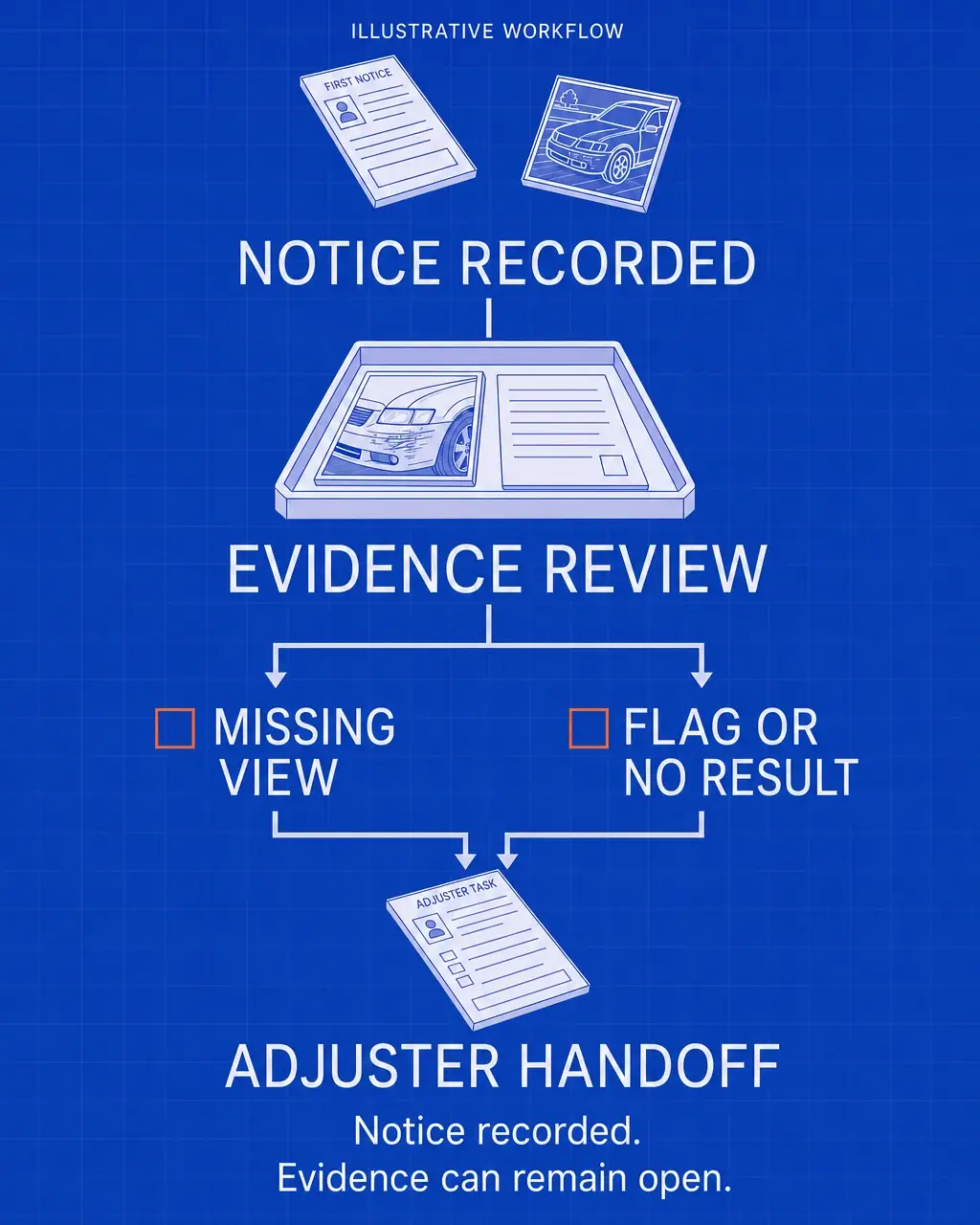
Authenticity review belongs after the insurer has received and preserved the evidence, before that file is treated as a reliable basis for an assessment or automated summary. The review can proceed while the intake team finishes other work. It does not have to block acknowledgment or every unrelated claims task.
Retain the file as received before converting it, extracting pages or adding annotations. Link any working copy to that original and record which version was analyzed. The National Institute of Standards and Technology's digital evidence guidance supports retaining source information and protected file hashes. A hash, a digital fingerprint of a file, helps show that the received bytes have stayed unchanged. It cannot establish that the depicted loss is true.
Keep evidence completeness and authenticity status in separate fields. A full set of photographs can still contain a manipulation concern. A genuine photograph can omit the only view needed to assess the damage. Record whether the required material is present and usable independently of what an authenticity check found.
Record whether analysis completed, and retain any finding that needs review. Give unavailable or incomplete assessments their own status. “No finding returned” is ambiguous unless the record also shows whether analysis completed. A timeout, unsupported file or missing page cannot quietly inherit a favorable status.
A detector score or localized signal is not a calibrated probability of claimant fraud, overall accuracy, ground truth or proof of intent. A completed check without a flag also leaves event truth and coverage unresolved. Missing camera data alone is insufficient to label a photograph fake; our claim photo guide explains the file-level signals and their limits.
Request fresh capture for a defined gap
A fresh photo or guided remote inspection is useful when it can answer a specific intake question. For an auto loss, the existing close-up may show damage without identifying the vehicle. A targeted request can ask for a wider view linking that panel to the vehicle and its relevant identifier. For a property loss, a room-level view can connect a close-up to the reported location.
State the requested view and why it is needed. “Provide a wider view linking the damaged panel to the vehicle” is more actionable than “send better evidence.” Retain the earlier submission and its unresolved status alongside the new material.
Distinguish an ordinary upload from a capture process that supplies verified time, location or session evidence. Claim those properties only when the selected collection method actually records and supports them. A new upload alone supplies no such assurance. This is an insurer-owned collection or inspection step, separate from Trustable's checks on submitted files.
Fresh capture shows present condition. It cannot recreate the state before cleanup, repairs or further damage, and it cannot by itself establish when or how damage occurred. Historical questions may require earlier records or the adjuster's investigation.
Safety and access determine whether capture is appropriate. Do not request roof access, entry to unsafe premises or a roadside photograph that exposes the claimant to danger. Offer an assisted route or suitable inspection when the person cannot complete the request. The National Association of Insurance Commissioners' post-disaster claims guide puts safety first, alongside documenting damage and taking essential steps to prevent further loss. Evidence collection should not delay emergency help or necessary mitigation.
Send exceptions to an adjuster with a question to resolve
An intake exception should describe the work required. Keep missing evidence, authenticity concerns and technical failures distinct:
- Missing or unreadable material needs a specific request, a request owner and a follow-up date.
- An authenticity finding needs the received file, the supplied finding and its location or scope, with any relevant limitation. The adjuster determines the next evidence or review step.
- An unavailable assessment needs a technical owner for recovery and an adjuster who knows which claim evidence remains unassessed.
- An impractical or unsafe capture request needs an alternative collection plan, without treating inability to comply as evidence of deception.
The handoff should carry the loss account, evidence references, outstanding questions, any requests already sent and the person responsible for claimant communications. Include the detector's actual response, available run details and input version. Do not invent a page marker or timestamp when the service supplied only a whole-file finding.
Route to a named adjuster or staffed queue and record acceptance. Until that happens, the sending team retains an explicit follow-up responsibility under the insurer's operating procedure. A task marked “sent” is insufficient evidence that someone is handling it. Specialist investigation follows the insurer's referral criteria; an intake flag does not automatically establish a fraud case.
Consider this illustrative first-contact note, not a customer outcome:
Vehicle loss reported by phone. Notice recorded. Two forwarded close-up photos retained under the notice reference. Neither shows the vehicle identifier. One photo returned an authenticity finding; the original response and analyzed file are attached. Intake requested a safe wider view through the approved channel. Assigned adjuster accepted the evidence-gap task and owns the next contact. No coverage or fraud conclusion recorded.
The adjuster can now distinguish a missing context view from a detector concern and decide what evidence is needed next. Any restriction on using a file should identify its scope and owner. An internal evidence task does not itself authorize denial, suspend all claims work or change applicable handling deadlines.
Define the authenticity handoff in the buying brief
An FNOL request for proposal should specify the control at the attachment level. Require a written answer for:
- Supported inputs and analysis scope, including what happens to forwarded photos, multipage documents and incomplete video.
- Returned evidence, including reasons, any localization, limitations and the link to the exact input analyzed.
- Missing-result handling, with incomplete, unsupported and failed assessments distinguishable from completed checks without findings.
- Delivery responsibility, including who attaches results to the insurer's record, who receives exceptions and how acceptance is recorded.
Keep intake capture, policy matching, coverage decisions and the adjuster's authority outside the authenticity supplier's scope unless separately contracted and supported. At Trustable, our role is to supply submitted-file findings for review. The insurer owns the surrounding process and consequential decisions.
Book a demo to see our findings on a sample claim file and discuss where the review belongs in your FNOL workflow. Customer files are used only after data handling is agreed in writing.