
A claims inbox receives a repair estimate, photographs, correspondence and a revised invoice. Someone must connect those files to the right claim, capture the relevant details and resolve anything missing before an adjuster can use them.
Buying software for that work requires a precise scope. Document processing, authenticity analysis and claims administration supply different capabilities. A useful buying brief defines the output each system owes the next team, including what happens when processing is incomplete.
What intelligent document processing does
Intelligent document processing (IDP) for insurance converts incoming documents into structured records for operational workflows. Its core processing functions can include document classification, packet splitting, and field or table extraction. The insurer’s complete workflow also needs defined validation, routing and exception-handling requirements. Those capabilities may live in a dedicated platform, a core-system module or an integration assembled from separate services.
Optical character recognition (OCR) supplies recognized text. IDP connects text and document context to a defined task, such as capturing an invoice total and attaching it to the correct claim. Document storage serves another purpose: preserving and retrieving the files. Neither a searchable repository nor a text-extraction endpoint automatically provides the full processing workflow.
At Trustable, we focus on document and media authenticity for businesses reviewing evidence before paying a claim. Our insurance claims work belongs alongside the document-processing stack. Classification, extraction and field validation remain a separate buying job. Routing Trustable results into an insurer’s claims system is in development; the insurer needs an operational routing and exception-handling path in its chosen IDP workflow.
Start with the work arriving in the queue
The buying scope should name the document families, intake channels and destination records. “Insurance PDFs” leaves out the details that determine whether a system fits.
| Workflow | Typical incoming material | Required processing output |
|---|---|---|
| Claims intake | First notice of loss, estimates, invoices, correspondence and supporting records | Documents associated with the correct claim, extracted fields with source locations, and unresolved items assigned for review |
| Underwriting submissions | Applications, loss runs, statements of values and broker emails | A structured submission that preserves which document supplied each value and highlights conflicts |
| Policy servicing | Endorsement requests, renewal forms and correspondence | A classified request linked to the relevant policy and routed to the responsible team |
| Insurance finance | Premium or claims bordereaux, remittances and statements | Normalized rows, reconciliation exceptions and traceable records for the finance workflow |
An initial deployment needs a bounded job, such as processing repair invoices for an existing claims queue. The scope can expand after the operational handoff works. It does not need to start with every document across every line of business.
Structured inputs also deserve a direct path. A usable data feed or spreadsheet may need mapping and validation without image recognition or generative extraction. AI should serve the input rather than become a mandatory stop for every record.
Make the functional requirements concrete
A buying brief needs required outputs and clear ownership, especially when several systems contribute.
| Function | Requirement | Evidence the proposed workflow should produce |
|---|---|---|
| Ingestion | Accept the actual email, portal and batch inputs in scope; identify unreadable or unsupported files | A receipt linked to the original submission, its attachments and processing status |
| Classification | Identify document types and retain an unknown or ambiguous state | A document label, the relevant pages and a review reason where classification is unresolved |
| Packet splitting | Separate documents without losing their relationship to the submission | Parent-file identifiers and page ranges for every resulting document |
| Extraction | Capture required fields and repeated table rows, including multipage tables where needed | Raw values, normalized values and source locations, with missing values distinguished from failed extraction |
| Field validation | Apply agreed format, completeness, arithmetic and record-matching rules | Rule results that identify the field, rule version and reason for an exception |
| Routing | Send the record to the right destination under insurer-owned policy | A destination, routing reason and acknowledgment from the receiving system |
| Exception handling | Let authorized staff resolve an issue without losing the original result | Corrections, reviewer rationale, ownership and a controlled path back into processing |
The packet boundary matters. A file can contain several document types, and a correspondence page can refer to more than one claim. File-level classification alone may leave the team with the same manual sorting work it had before.
Extraction requirements also need field-level detail. An invoice total, a date of loss and a line-item quantity have different meanings and failure consequences. Preserving the original value alongside a normalized value makes a date-format conversion or currency interpretation visible.
Define what “validated” means
Validation needs a named rule and a named source of truth.
A format rule can establish that a policy number has the expected shape. Arithmetic can establish that invoice lines reconcile to the stated total. Matching against a policy system can establish whether the extracted policy reference exists in that system. Each result answers a limited question.
An internally consistent invoice may still be altered. A correctly extracted total may faithfully reproduce a false amount. Conversely, a genuine invoice may fail extraction because its scan is unreadable. Authenticity and extraction quality therefore need separate result fields and separate routing rules.
Document-authenticity analysis looks for indications of manipulation or AI generation in the submitted file. A detector score is not extraction confidence, calibrated fraud probability, overall accuracy or proof of intent. A localized signal identifies a concern for review; it does not establish ground truth for the highlighted region or certify the rest of the document. The same distinction applies to AI-generated claim photos: a file-level finding does not establish whether the reported loss occurred.
When authenticity analysis is part of the design, preserve the submitted original and identify every derived version. Splitting, conversion and redaction can change the artifact available to a later check. The processing plan should define which version each service receives and keep the relationship between that version and the original.
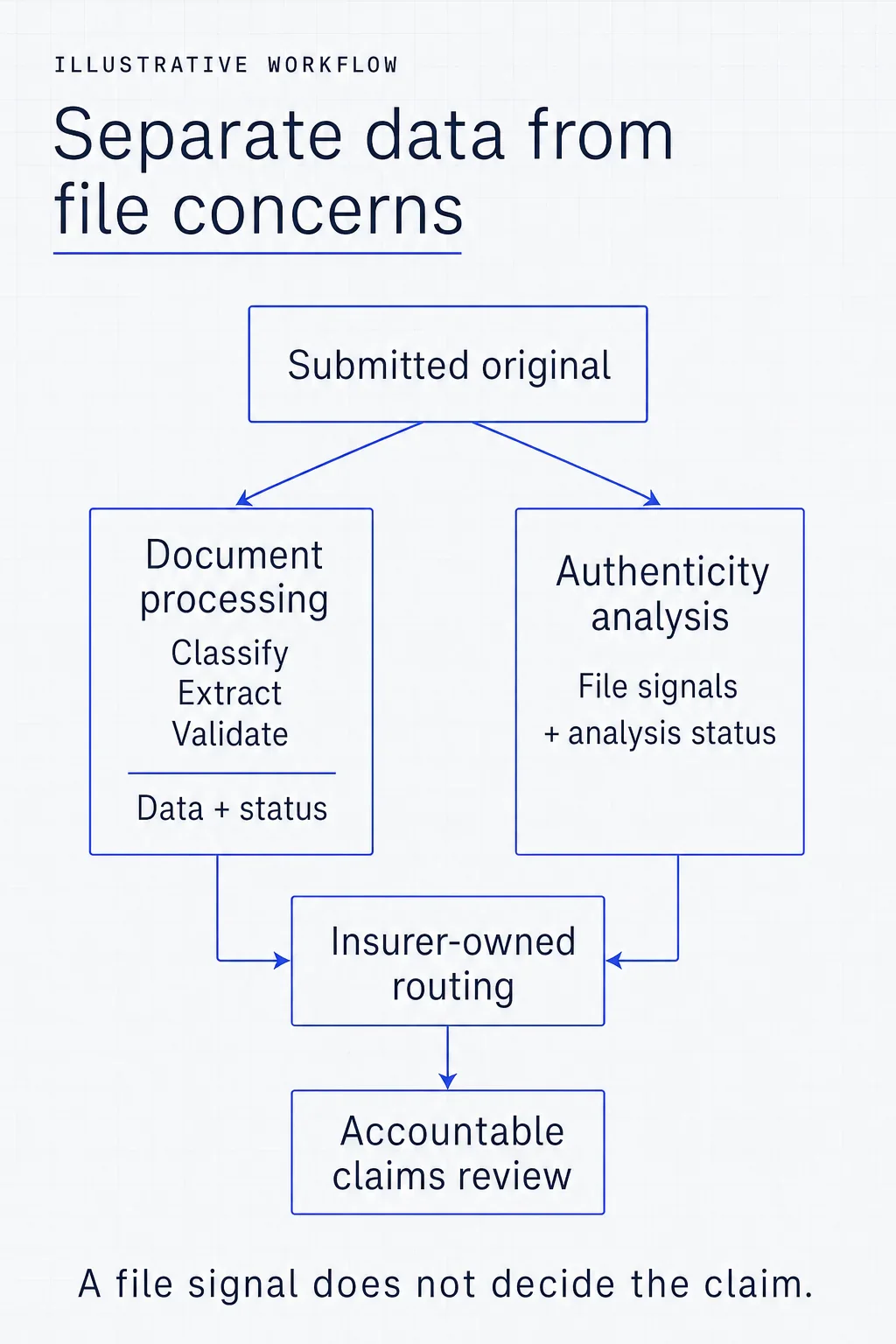
Independent corroboration remains another control. Issuer records or other authorized source evidence may resolve a concern that a file-level analysis cannot. An adjuster or investigator weighs that evidence under insurer policy. The IDP system’s job is to preserve the relevant record and route it correctly.
Give every exception an owner and an exit
A generic “manual review” queue conceals several different jobs. Correcting a misread claim reference belongs with intake staff, while conflicting estimates may need an adjuster’s attention. Suspicious alterations can require investigation. The system needs reasons specific enough to send the work to the right person.
In an illustrative routing policy, “data ready” means the defined processing requirements are satisfied. “No authenticity flag” means an applicable check completed without raising a concern; it does not prove authenticity. These example routes are not customer outcomes or product benchmarks.
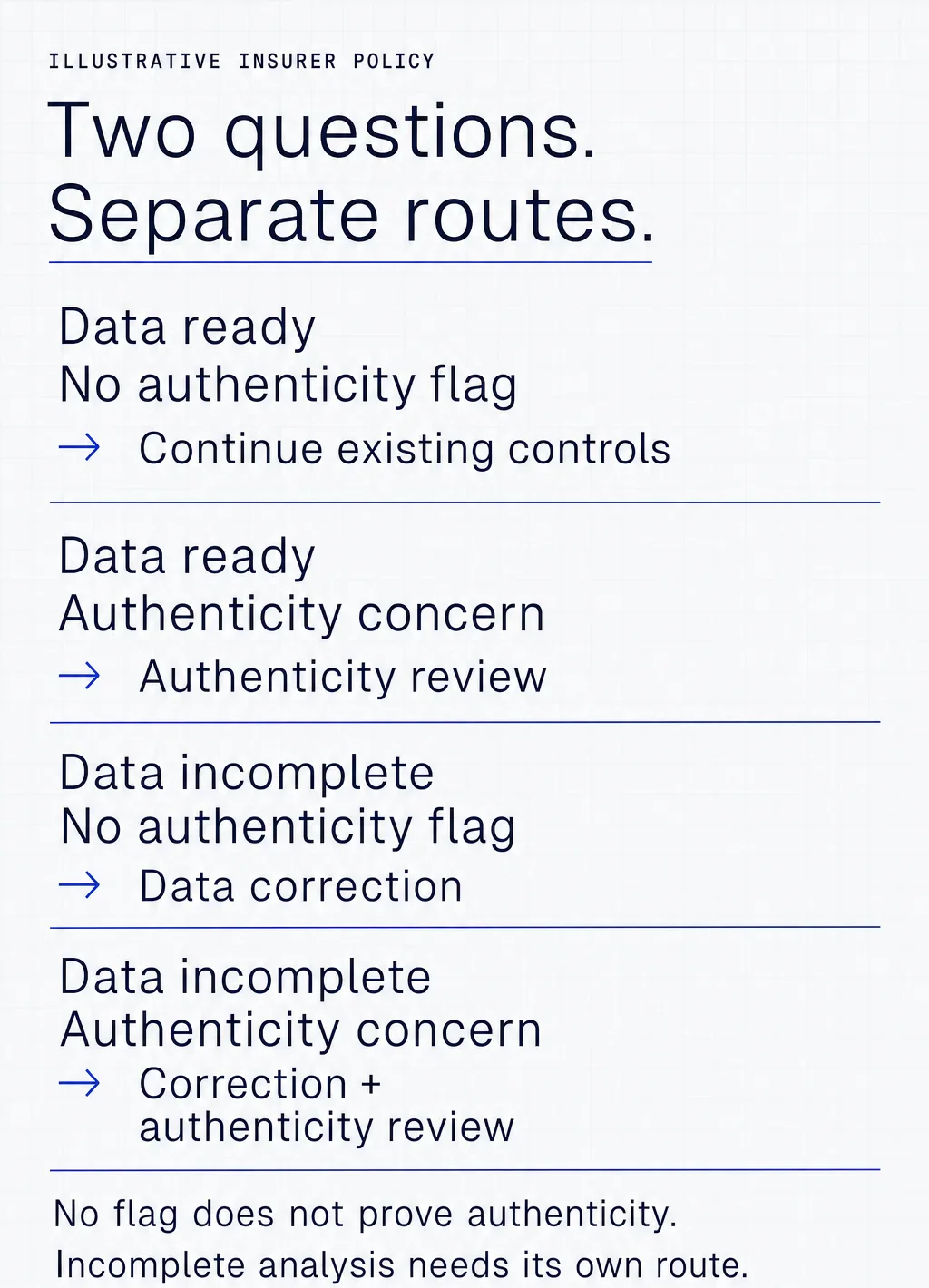
An unsupported file, unavailable service or incomplete analysis needs its own state. It cannot enter the “no flag” path simply because no alert arrived. The insurer’s policy determines whether processing pauses, an alternative evidence path is used or a named reviewer takes over.
Corrections need an exit path too. A corrected value should carry the reviewer’s identity and reason, trigger the applicable validation rules again, and return to the appropriate workflow stage. Reprocessing must not overwrite an earlier decision without a trace or create duplicate claim activities.
Require an operational integration contract
An application programming interface (API) makes a connection possible. Operational integration determines whether the record reaches the right place, remains understandable and survives a failure.
| Integration area | Requirement to settle before rollout |
|---|---|
| Identity and association | Stable submission, file, page, policy and claim identifiers; a defined response to ambiguous record matches |
| Output schema | Field names, data types, currencies, dates, source locations and distinct missing, unreadable and unsupported states |
| Completion | A clear distinction between receipt, processing completion and successful writeback to the destination system |
| Retries and recovery | Duplicate-safe requests, bounded retries, timeout handling and a recoverable queue for failed handoffs |
| Human review | Role-based access, original-document viewing, corrections, escalation and return-to-workflow behavior |
| Change control | Versioned extraction configurations, rules and models, with release notification and rollback arrangements |
| Data handling | Processing locations, retention, deletion, subprocessors, access logging and contractual training-use terms |
| Exit | Exportable originals, structured records, review history and mappings in usable formats |
A successful extraction response does not mean the claims platform accepted the update. That distinction should be visible to operations, along with the owner of a failed handoff.
For AI-assisted extraction, uploaded content also needs to remain data. Indirect prompt injection can arrive through instructions embedded in documents. Text inside a submission must not gain authority to change workflow rules or direct unrelated system actions. The application’s permissions and approval boundaries belong outside the document.
Evaluate the whole processing path
A useful pilot includes complete submissions with their attachments, channel context and destination mappings. A collection of clean single-page forms cannot demonstrate packet splitting, record association or exception recovery.
The National Institute of Standards and Technology’s AI risk framework calls for documented evaluation methods and performance demonstrated under conditions similar to deployment. Applied to insurance IDP, that means a representative document mix and measured handoffs as well as extraction results.
The evaluation record should separate:
- Classification mistakes, incorrect page boundaries and wrong claim associations.
- Field and table errors, including missing values that should have been present.
- Validation failures, unsupported inputs and incomplete processing.
- Review effort, queue aging, rework and successful delivery into the destination system.
Field-level confidence needs a documented meaning. It describes an extraction prediction under the service’s definition; it does not establish that the document’s contents are true. A blanket threshold across every field and document type can obscure meaningful differences. The pilot should demonstrate the proposed routing policy against human-confirmed answers, including errors that passed without review.
Cases used to tune extraction or routing need separation from the held-out cases used to assess the final configuration. Results should remain broken down by document family, source and input quality. Unsupported and failed submissions stay visible in the denominator of operational reporting.
Commercial evaluation should follow the same end-to-end boundary. Total workflow cost includes software charges, integration, exception handling, follow-up and ongoing change management. Quotes need explicit billing treatment for pages, reprocessing, failed jobs and peak volumes, alongside support and deployment terms. Extracting a field cheaply provides little value if staff must reconstruct its source or repair its destination record.
Keep insurance decisions accountable
IDP prepares information for claims, underwriting and servicing. The authority to determine coverage, settle a claim or take an adverse action needs a separate, explicit policy boundary.
For US insurers, the National Association of Insurance Commissioners’ model AI bulletin sets out governance expectations for AI-supported insurance practices, including third-party diligence and documentation. It is a model for jurisdictions, not a single nationwide IDP certification. Applicable obligations depend on the jurisdiction and use case.
The retained record should connect the submitted material, extracted values, validation results, relevant authenticity evidence and any human corrections to the action ultimately taken. Insurer-owned routing policy and reviewer rationale belong alongside system versions. A processing result alone is an incomplete decision history.
Put authenticity in the right place
We recommend selecting IDP around the document-processing requirements first, then defining where authenticity evidence supports the insurer’s review. The buying brief should keep each supplier’s supported inputs, outputs and operational responsibilities explicit. Our evaluation approach keeps file evidence separate from the decision it informs.
Some questions need evidence beyond the submitted packet. Property condition may require guided remote capture or an in-person inspection. Issuer confirmation may resolve a question about an invoice. These are separate evidence-collection steps, with their own scope and accountable reviewer. Neither IDP nor an authenticity finding establishes the whole claim.
Book a demo to discuss where Trustable’s document and media checks could support your insurance intake workflow, alongside your IDP and claims systems.