
In bank trade finance, trade fraud means deliberately misrepresenting a sale, shipment, goods or receivable to obtain financing or payment. It can leave a bank funding a transaction that never happened, goods worth less than described, or an exposure already financed elsewhere.
The paperwork may look ordinary. For trade-finance operations, credit and financial-crime teams, the useful question is what each record actually establishes, and which parts of the transaction still lack independent support.
Where document evidence fits
An invoice records a demand for payment. Shipping documents describe transport. A financing application connects those records to a request for funds. Agreement between them helps a reviewer understand the story presented to the bank. It does not establish that the story is true.
At Trustable, our document-first content-trust approach keeps file integrity separate from the truth of a transaction. We are building around evidence a reviewer can interpret, with people accountable for the next action. In trade finance, that kind of analysis belongs alongside the bank's existing credit, documentary and financial-crime controls. It cannot establish that goods exist, a shipment occurred, counterparties are genuine or funds arrived.
This is a transaction-level problem. An altered invoice may be one clue. A purported trade supported by several apparently consistent records needs a wider review.
Common forms of trade-finance fraud
The deception can concern the trade itself, its value or the financing attached to it.
| Pattern | What is misrepresented | Why a plausible file is insufficient |
|---|---|---|
| Fictitious trade | A sale, shipment or receivable is presented as real when it does not exist. | Matching references can repeat the same invented event. |
| Misdescribed goods or value | The quantity, quality, type or price is deliberately misstated. | An invoice cannot establish the contents or condition of a cargo. |
| Undisclosed duplicate financing | The same goods or receivable support overlapping funding contrary to the agreed arrangement. | A genuine invoice can be reused without changing its appearance. |
| Concealed circular or related-party arrangements | Transactions are presented as independent commercial sales while hiding relationships or an artificial funding purpose. | Documents can agree because the parties coordinate their account. |
The Trade Finance Principles, issued by the Wolfsberg Group, International Chamber of Commerce and the Bankers Association for Finance and Trade, describe phantom shipping, multiple invoicing and misrepresentation of goods. They also explain why collusion and limited pricing context make these risks difficult to identify from documents alone.
Related-party trade, refinancing and goods changing ownership without moving can be legitimate. Fraud concerns deliberate deception in the financing arrangement.
Trade fraud and trade-based money laundering are different questions
Trade-finance fraud concerns deception used to obtain financing or payment. Trade-based money laundering concerns disguising criminal proceeds and transferring value through trade. The same transaction can involve both, but a false invoice alone does not establish money laundering. The Financial Action Task Force defines it around concealing the illicit origin of value.
Consistent documents can share one unreliable source
A packet is internally consistent when its dates, parties, quantities and transaction references fit together. Independence concerns where those assertions came from.
An applicant can supply an invoice, a transport-document copy and a buyer confirmation. Those are separate files. Until their claimed origins are established, they may still be one party's account of the transaction. A forwarded email does not become independent evidence simply because it displays another company's name.
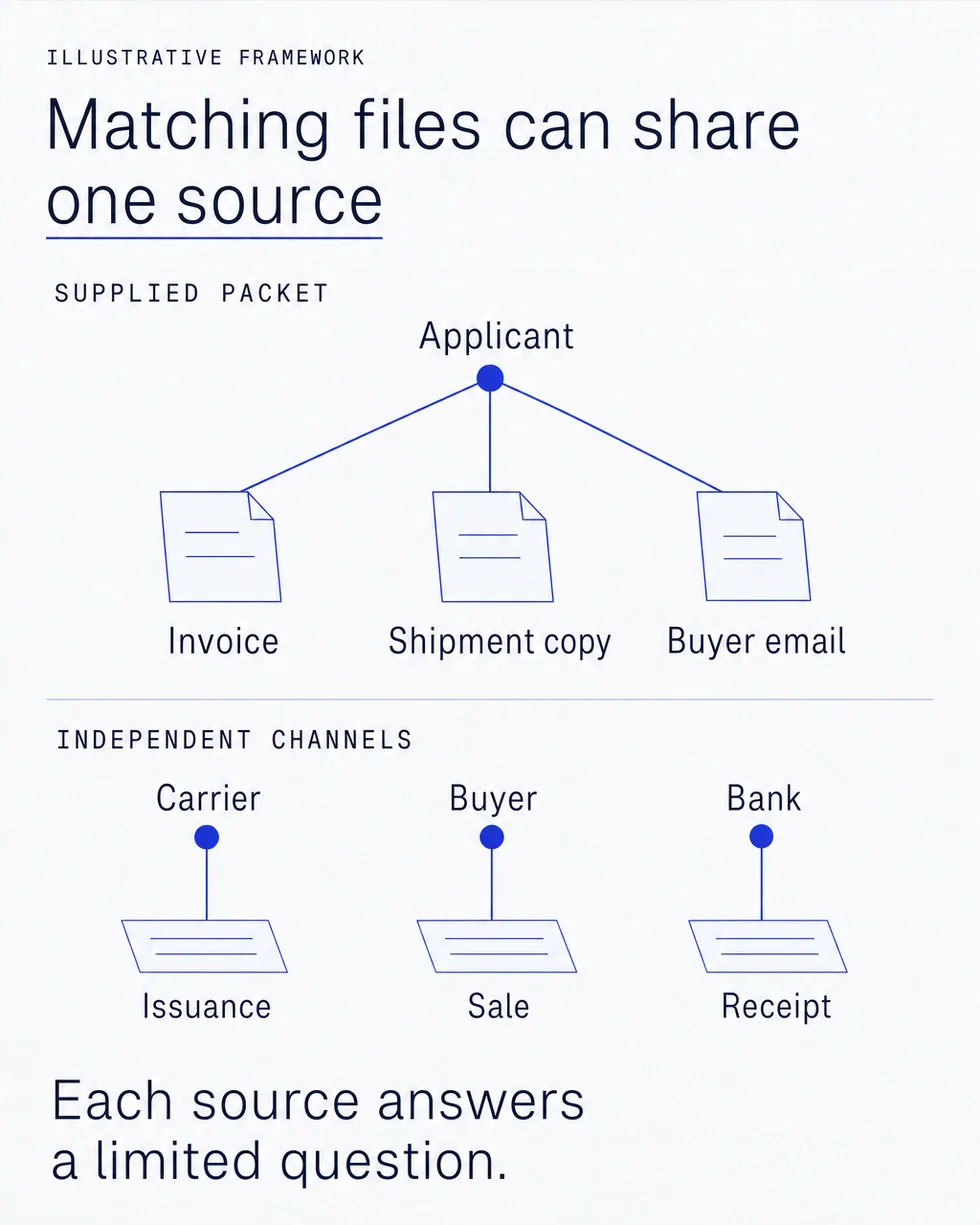
A useful review record therefore distinguishes:
- A claim supplied by the applicant.
- A finding from analysis of the submitted file.
- A response obtained through an independently established source channel.
- A fact corroborated for a specific purpose, with any remaining limits recorded.
A carrier's confirmation that it issued a transport document can answer an issuance question. It does not, by itself, answer every question about cargo contents, ownership or other financing. Independence improves the evidence; the scope of that evidence still matters. An authentic reply from a colluding party can still be false.
In the Hin Leong case, the Singapore High Court's appeal judgment records that the purported oil-sale contracts and supporting documents accompanying the financing applications were fictitious. The lender received a packet supporting receivables financing. The existence of that packet did not make the underlying sales real.
An evidence map for the underlying trade
The practical unit of review is a claim the bank needs to rely on. Different facilities give the bank different visibility and rights, so the evidence plan follows the product, the bank's role and the transaction's risk.
Singapore's commodity-financing code illustrates that distinction. It addresses both business due diligence and transparency over financed goods and receivables, including independent verification where warranted by risk. Its examples are specific to that lending context, rather than a universal checklist for all trade finance.
| Claim supporting the financing | Evidence beyond the applicant's packet | Limit that stays visible |
|---|---|---|
| The goods exist and match the description. | Appropriate inspection or stock evidence from a qualified, independently engaged source; commercial context for grade and value. | A visit or report has a date and scope. It does not establish continuous custody or every ownership claim. |
| The described shipment occurred. | Transport-document issuance confirmation and relevant carrier, port or shipment records obtained through established channels. | A vessel's movement does not establish that this cargo was aboard. A booking is different from evidence of loading. |
| The parties and sale are genuine. | Customer and beneficial-ownership information, the commercial rationale, and a buyer response through independently established contact details. | A registered company can still participate in a false transaction. A response needs an authorized source and a defined scope. |
| The goods or receivable are eligible for this financing. | The bank's exposure history, assignment and security records, and permitted external information about other funding. | The bank's own records cannot reveal every other lender's exposure. No single invoice proves the absence of competing claims. |
| The expected payment reached the right account. | Account and settlement records available to the bank, reconciled to the receivable and expected payer. | A remittance advice or payment screenshot is a claim about payment, not confirmation of receipt. |
What an anomaly means for the reviewer
An anomaly creates a question to resolve. Examples include conflicting shipment dates, an unexplained beneficiary change, a buyer outside the customer's established business, or repeated references across financing requests.
The Financial Action Task Force (FATF) and Egmont Group's trade risk indicators span business structure, trade activity, documents and account activity. Their handling notes stress context: an indicator does not necessarily establish suspicious activity, and some indicators require external information unavailable to a bank.
The same restraint applies to technical findings. A metadata gap, a localized manipulation signal or a detector score does not establish fraudulent intent. A score is not automatically a calibrated probability of fraud, an accuracy figure or ground truth. A file with no detected manipulation may still contain false assertions.
A bank-owned path from concern to decision
The workflow needs an owner before a flagged packet arrives. Trade operations can resolve documentary questions; credit assesses the financing exposure; financial-crime specialists assess suspicious activity; legal handles questions about obligations and available action. The bank's policy determines the handoffs.
The submitted version stays intact
The case retains the files as received, submission details and version history. Analysis findings remain linked to the exact file and relevant page or field. A replacement document can add evidence without erasing what prompted the review.
The finding is described narrowly. “The amount differs between these records” is an observation. “The applicant committed fraud” is a conclusion that the observation does not establish.
An open question needs an owner
For each material question, the record identifies the required evidence, the person responsible and the decision it affects. The distinction between applicant-supplied information and independently obtained responses remains visible.
For example, a shipment question may go to the trade-risk function for carrier corroboration. A competing-assignment concern may need credit and legal review. A possible sanctions or money-laundering issue follows the bank's financial-crime process. A generic “needs review” label leaves too much unresolved.
The decision explains the remaining uncertainty
The accountable reviewer records what was established, what remains uncertain and why the permitted action follows. An explanation may resolve a discrepancy. An unanswered material question remains open. The next action follows the applicable facility, policy and legal obligations, rather than an automatic fraud verdict from a document tool.
Monitoring continues where the exposure requires it. The Monetary Authority of Singapore's commodity-financing review discusses transaction controls, storage and vessel monitoring, and post-transaction review. Evidence gathered after funding can change the assessment of an outstanding exposure or later requests.
Documentary-credit rules have a specific scope
A letter of credit is not a general certification of the underlying trade. The International Chamber of Commerce's Uniform Customs and Practice for Documentary Credits, UCP 600, applies when the credit expressly incorporates it. Article 5 distinguishes the bank's examination of documents from the goods or performance those documents describe. UCP 600's rules also separate the credit from the underlying sales contract.
That distinction does not give a bank a blanket instruction to disregard suspected fraud or stop payment. Available actions depend on the instrument, applicable law, jurisdiction and facts. Credit, financial-crime and legal teams own those decisions. A detector finding cannot decide whether a bank may refuse, delay or honour a presentation.
Where Trustable belongs in the review
Our focus is document evidence that helps people make a better-supported decision. A trade-finance use case starts with a defined file type, a review question and an accountable team. Format support, available findings and the handoff into the bank's process need an agreed scope. Cross-document checks are in development. Trustable does not establish the truth of the underlying trade.
Our evaluation approach keeps those boundaries visible. A useful file finding narrows an investigation. The bank still owns corroboration of the trade and the financing decision.
Book a demo to discuss where document evidence could support your trade-finance review. We agree on data handling before files are shared.