
A construction project can look busy while a draw request runs ahead of the work. The lender needs a record that connects the requested funds to the approved scope and progress on the right property. Construction-loan teams need to understand the inspector’s assignment and the separate reviews that follow it before money moves.
What is a draw inspection?
A draw inspection is a construction-progress inspection that helps a lender assess a request to release part of a construction loan. A draw is an advance from that loan. The inspection documents the stage reached and the work completed against the scope covered by the request. Its record may include progress estimates by budget line item and photographs.
The report supports the funding review. It does not itself authorize payment. The lender also considers the loan terms, prior advances, required documents and funds needed to finish the project.
U.S. bank supervisory guidance treats inspections as one control within construction-loan administration. The Federal Deposit Insurance Corporation (FDIC) addresses inspection reports, budget monitoring, lien-related controls and disbursement review in its construction lending examination procedures. These procedures assess how banks compare draws with construction progress and monitor the funds remaining.
At Trustable, we check submitted documents and media for signs of editing or AI generation and return findings for human review. Our content authenticity checks address evidence integrity. A clear photo can support a construction observation, and an authenticity signal can support review of that photo. Neither establishes that every condition for disbursement has been met.
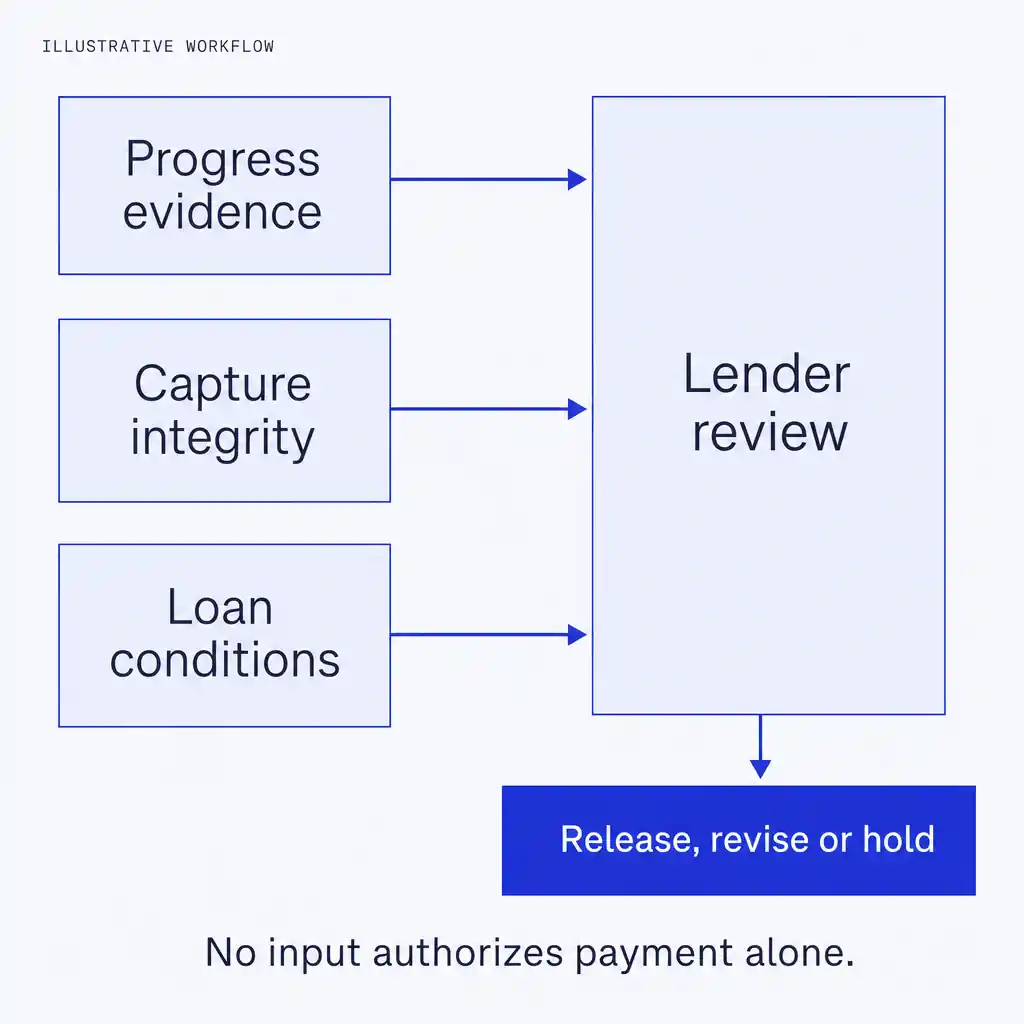
Where a lender accepts remote collection, its inspection instructions can specify views tied to the draw request and require the collector to note any areas that cannot be observed. The construction reviewer assesses what those views support. Capture-integrity checks address the submitted evidence, while release authority remains with the lender.
What the inspector looks for
The starting point is the approved project scope and the particular draw request. A milestone might be a completed foundation or framing stage. A percentage-based request might cover partial progress across several cost categories. The inspection needs to match the payment structure rather than apply a generic list of construction stages.
A useful inspection record connects each observation to the relevant budget line:
| Area of review | Evidence that helps the lender | Limit the report should preserve |
|---|---|---|
| Property and scope | Project identifier, site context, inspection date and the scope version used | A close-up alone may not establish which building or unit it shows |
| Work in place | Descriptions, location-specific photos and an assessment of completion for the relevant line items | Visible activity is different from completion of a funded milestone |
| Change since the previous draw | Prior observations beside current progress and an explanation of material differences | Previously reported work must remain distinguishable from new progress |
| Stored materials | Materials observed, their location and their relationship to the request | Delivered materials are different from installed work; funding eligibility needs separate review |
| Exceptions and access limits | Missing views, inaccessible areas, apparent scope differences or signs of stalled work | An unobserved item cannot be treated as confirmed complete |
The distinction between observation and inference matters. A photo of roofing materials on the ground shows stored materials. It does not establish that the roof has been installed. A front elevation does not document every room, floor or building in the request.
How a draw request moves toward release
The inspection sits inside a longer review. Responsibilities can be combined or assigned differently under a lender’s program, but each handoff needs a named owner.
The borrower or contractor submits the request
The request identifies the amount sought, the billing period and the work or costs behind it. Loan administration connects it to the approved budget, earlier requests and any approved changes. Supporting records may include a payment application, invoices and the lender’s required lien-related documents.
The inspection order needs the same scope version as the draw package. Otherwise, the inspector and the funding reviewer may be evaluating different work.
The assigned inspector records progress
The lender assigns an appropriately qualified person for the scope. That may be an internal inspector or an outside construction professional. The FDIC addresses inspector qualifications, independence and reports detailed enough to support disbursements in its construction lending examination procedures.
The inspector compares observed progress with the request and records limitations. A borrower’s statement that work is finished can explain a request, but it remains distinct from the inspector’s observation. Work hidden behind finishes may require earlier inspection records or another qualified review.
Loan administration reconciles the package
The inspection report joins the rest of the draw file. The reviewer reconciles reported progress with amounts requested and previously funded. Required waivers, title information and other loan conditions follow their own review paths.
For example, Live Oak Bank’s draw documentation requirements separate the contractor’s payment application and supporting documents from the site inspection, title endorsement and insurance information the bank confirms. Its requirements illustrate why a satisfactory progress report is only part of a complete package.
The lender resolves exceptions and authorizes the advance
The authorized lender reviewer decides whether the evidence and loan conditions support release, a revised amount or a hold. Where policy permits a partial release, the file needs to distinguish supported amounts from unresolved items.
Funding operations then follows the authorized instructions. The retained record connects the request, supporting evidence, exception resolution and approval to the actual disbursement. An inspection status such as “complete” describes the inspection workflow; it is not interchangeable with “funds authorized.”
Why percent complete is different from the current draw amount
Completion is often cumulative. The current advance must also account for what has already been funded and the applicable payment terms.
Illustrative example: A framing line has an approved value of $80,000. The current inspection supports 50% completion, representing $40,000 of cumulative work. The lender has already funded $24,000 against that line.
| Simplified framing calculation | Amount |
|---|---|
| Approved line value | $80,000 |
| Cumulative work supported at 50% completion | $40,000 |
| Less previous funding against the line | $24,000 |
| Newly supported amount before other adjustments | $16,000 |
This example leaves out retainage and other adjustments. Retainage is an amount withheld under the applicable payment terms. A real release can also depend on eligible stored materials, borrower contributions and the rest of the loan conditions. The $40,000 cumulative figure is not a fresh $40,000 draw.
Payment applications preserve these distinctions. AIA Contract Documents’ payment application instructions separate prior work, current work and materials presently stored. That separation helps prevent the same materials from being counted again when they move from storage into installed work.
When previously funded materials are installed, their value moves out of the stored-materials balance and into work completed for that period. The payment review still accounts for prior funding.
Progress also needs to be weighted against the budget. Finishing half the listed tasks does not necessarily mean half the project’s budgeted value is complete.
Remote inspections still need construction judgment
Remote evidence can support a draw review when the lender’s program accepts that approach and the required work can be adequately observed. The person holding the camera may be a borrower or contractor rather than an independent inspector. The file needs to preserve that distinction.
Two separate questions remain:
- Does the submission show the claimed progress? The construction reviewer needs views tied to the requested scope, enough site context and an explanation of what could not be observed.
- What supports confidence in the capture? The evidence reviewer considers the capture source, available time and location information, file history and any authenticity signals. An upload time is different from the time the work was photographed.
The National Institute of Standards and Technology’s digital content guidance explains that transparency about content’s origin and history may contribute to trustworthiness without guaranteeing it. For a draw review, a genuine image can still show an earlier stage or the wrong project.
A detector score or localized flag is a review signal. It is not calibrated fraud probability, proof of intent or a construction finding. An inconclusive result leaves a gap; it does not clear the submission.
An independent site visit or specialist assessment remains the appropriate escalation when remote evidence cannot answer the assigned question. Camera access, image authenticity and qualified construction judgment serve different purposes.
How exceptions affect the next action
A discrepancy needs a specific resolution path. Treating every exception as suspected fraud loses useful distinctions between incomplete work, missing evidence and inconsistent records.
| Finding | What remains unresolved | Responsible review path |
|---|---|---|
| Observed progress falls below the request | How much of the requested amount is supported | Inspection reviewer explains the difference; loan administration reconciles the amount for the authorized lender decision |
| Materials are present but uninstalled | Whether the loan permits funding those materials and what documentation applies | Loan administration reviews eligibility and supporting records separately from installed progress |
| Required views are absent or unusable | Whether the claimed work can be observed | Inspection reviewer records the gap and routes it for additional capture or an independent visit |
| The work differs from the approved scope | Whether a change has been accepted and funded | The lender’s designated change-control owner resolves scope and budget treatment |
| The remaining budget appears insufficient | How completion will be funded | Credit or construction-loan administration escalates the funding gap before release authorization |
| Media or document signals conflict with the package | Whether the evidence is reliable and how it relates to the project | The designated evidence reviewer seeks independent corroboration and records the outcome for the lender |
A clean authenticity result cannot resolve a missing change approval. A complete inspection cannot resolve an outstanding title condition. The decision record needs the outcome of each applicable review, including any approved exception and the person accountable for it.
What a draw inspection does not establish
The engagement defines what the inspector is responsible for assessing. A limited progress inspection does not automatically provide:
- A full assessment of workmanship, structural adequacy or concealed defects.
- A substitute for required building-authority inspections or occupancy approvals.
- An appraisal or other determination of the property’s market value.
- Proof that contractors and suppliers have been paid, or that the property is free of liens.
Some assignments include broader architectural or engineering review. Those duties need an explicit scope and suitable expertise. The existence of a draw report alone does not establish that they occurred. Lien documentation and program-specific legal requirements depend on the project, jurisdiction and loan arrangements.
At the final draw, a progress report showing finished work still sits beside the remaining release conditions. The FDIC’s disbursement review procedures address lien waivers before advances and confirmation of a certificate of occupancy before final disbursement. The exact package depends on the loan and project.
Timing and fees belong to the loan’s workflow
The site visit or remote capture is only one part of the elapsed time. Scheduling, access, report delivery and exception resolution can each affect when a lender reaches its decision. A promise about inspection turnaround does not establish a funding deadline.
Inspection charges and responsibility for paying them follow the applicable engagement and loan terms. A repeat visit or specialist review may have a separate charge. Treating inspection delivery and release authorization as separate milestones makes both the schedule and the fee discussion clearer.
Make the release decision traceable
A useful draw file lets another reviewer follow the amount requested to the observed work, understand the evidence limits and identify who authorized the advance. Remote capture and authenticity checks can strengthen that record while leaving construction judgment and lending authority with the responsible people.
Book a Trustable demo to discuss document and media evidence checks within your construction-loan draw review.