
A suspicious receipt or repair invoice can hold up an insurance claim or an expense reimbursement. Financial-document reviewers face the same problem. The difficult cases often look ordinary. A faded printout or replacement copy can look unusual for an innocent reason. An upload problem may have the same effect. Reviewers need a consistent way to resolve the doubt without turning a formatting concern into an accusation.
A useful review connects each concern to the evidence that can answer it, while preserving a record of how the decision was reached.
What makes a receipt fraudulent?
Fraudulent receipts misrepresent a purchase, payment or expense to obtain an improper benefit. The document may be invented or altered. A genuine receipt can also be used deceptively, such as supporting a personal reimbursement for an expense already paid by the company.
An invoice records billed goods or services; by itself, it establishes neither payment nor completed work.
Deceptive reuse matters. The Association of Certified Fraud Examiners (ACFE) describes multiple reimbursement schemes in which different supporting documents are used to claim the same expense more than once. Image authenticity alone cannot resolve that problem.
With Trustable, we check receipts and invoices for edited text, font and layout mismatches, metadata that conflicts with the claimed source, and line items or totals that do not reconcile. Findings identify the concern on the file and its signal strength for your reviewer. Our claims-document checks supply evidence before payout. They do not establish the purchase, payment or right to reimbursement.
We separate the review into four questions:
| Question | Evidence that helps answer it | What remains unproven |
|---|---|---|
| Has the submitted file been altered or generated? | The received file, its provenance and document-authenticity signals | Whether a purchase occurred or someone intended to deceive |
| Did the payment occur? | A transaction record obtained through an authorized bank, card or merchant channel | Which items were purchased or who is entitled to claim them |
| Does the purchase or work match this person, item and loss? | Merchant itemization, order details, delivery or service records, and asset identifiers | Whether the expense or loss qualifies under the applicable policy |
| Is this amount payable here? | Claim terms or expense policy, prior payments, credits and the reviewer's assessment | Whether an unsupported request was deliberately fraudulent |
An honest error, missing documentation and an ineligible expense need different treatment from suspected deception. A review record should preserve those distinctions.
Preserve the received file before working on it
The starting point is the file as received, together with the submission context. A screenshot of an attachment is a new file with a different history. A cleaned-up or re-exported copy should never replace the received version.
A useful intake record contains:
- The original attachment or upload, its filename and a stable case reference.
- The sender or submitter, receipt time and intake channel.
- The email or submission context, including any explanation already supplied.
- Each replacement file and the reason it was requested.
- Any conversion, compression, redaction or enhancement applied during processing.
Access belongs in an approved evidence system, with permissions and retention suited to the case. Review copies can carry annotations while the received file stays unchanged. Where paper is involved, the record also identifies who holds it and how the digital copy was made.
The National Institute of Standards and Technology's digital evidence guidance supports documenting the source and using securely stored hashes to help preserve file integrity. A cryptographic hash acts as a file fingerprint: a later match supports that the file has not changed since that fingerprint was recorded. It cannot establish that the receipt was truthful before collection.
The same caution applies to timestamps. A file created after the purchase may be a later download or replacement receipt. Missing camera metadata may reflect a screenshot or the intake channel. Those observations describe the file's history; they do not settle the transaction.
Receipt red flags need an explanation
A useful flag identifies a contradiction precisely enough to resolve it. “Looks fake” gives the next reviewer little to work with. “The claimed total differs from the merchant's itemized record” identifies a question and a source.
| Observation | A possible innocent explanation | Evidence that resolves the concern |
|---|---|---|
| A total or date looks different from surrounding text | Different printing, a handwritten addition or image processing | The merchant's transaction record or a replacement obtained through an independently established channel |
| Line items do not reconcile to the total | A missed adjustment or text-extraction error | The complete itemized receipt and a calculation using the visible source values |
| A pending payment amount differs from the receipt | A restaurant tip or a hotel/car-rental incidental adjustment | Final posted transaction details reconciled to the merchant record |
| The seller name differs between a U.S. credit-card statement and the receipt | An expanded or abbreviated spelling of the seller name | The underlying transaction and merchant order details |
| The receipt resembles a prior submission | A resubmission, shared expense or legitimate allocation | Both case histories, the underlying transaction and the amounts already paid |
| The file was generated or modified after the purchase date | An emailed copy, scan or replacement issued later | The submission history and a record retrieved from the issuing merchant |
Recalculation starts with the source image. Optical character recognition, or OCR, extracts text; an extracted digit is not automatically a faithful reading of the receipt. Unreadable values should stay unresolved rather than being guessed into a balancing total.
Multiply quantities by unit prices, then reconcile the subtotal, tax, discounts, tips and fees. For repair invoices, include labor hours, rates and parts. Rounding and the tax treatment of individual items can affect the calculation; a mismatch needs the complete itemization and the issuer’s explanation. A round total, a missing footer or an unfamiliar layout is weak evidence on its own.
The ACFE's expense review controls include comparing travel and expense locations and identifying missing purpose, date or time information. Those comparisons help locate questions in the claim's context. An unusual pattern still needs an explanation before it becomes a finding.
Independent corroboration starts with the source
Two attachments are not necessarily two sources. A receipt image and a payment screenshot supplied by the same person may both be useful, but neither independently confirms the other.
The evidence record should distinguish an uploaded representation from information retrieved through an authorized source channel. Examples include a corporate-card feed already held by finance, a merchant response reached through established contact details, or bank records obtained through a permitted connection. Access stays within the reviewer's authority, with customer consent where required. Passwords and one-time security codes do not belong in a receipt-review request.
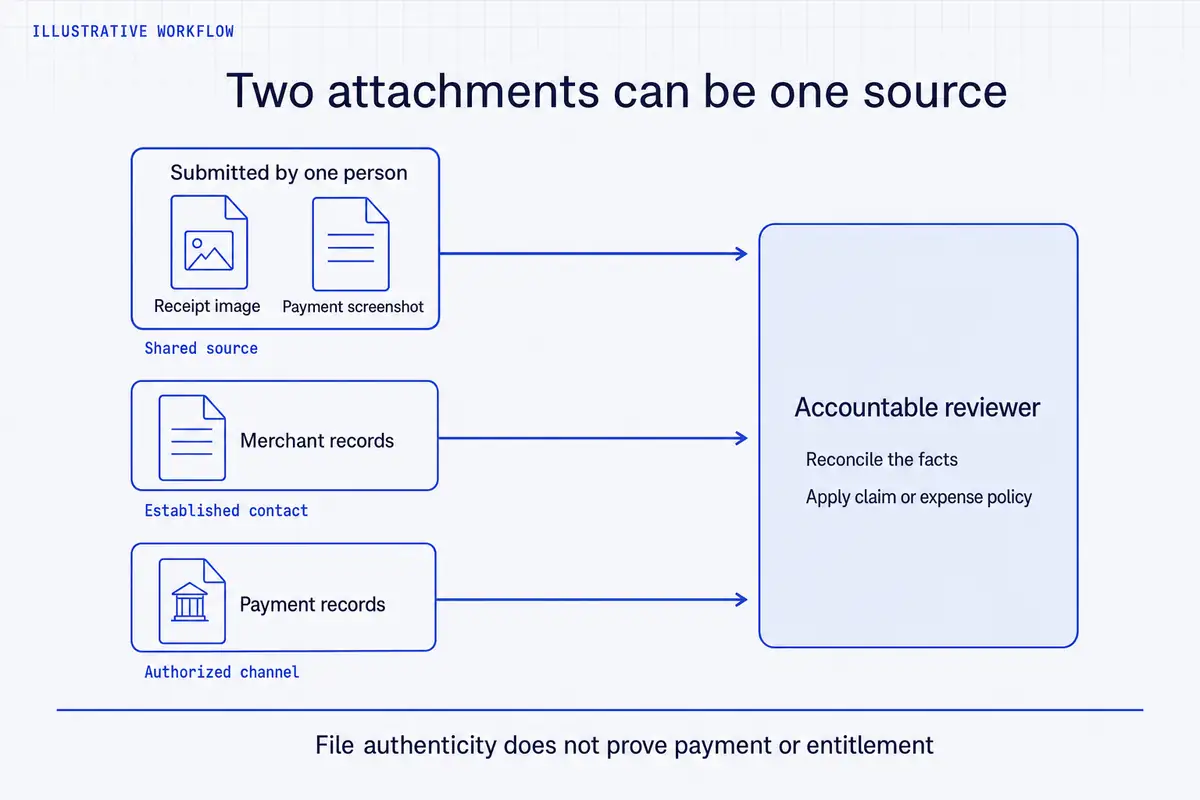
Merchant contact details printed on the questioned receipt are part of the questioned evidence. An existing supplier record, established account portal or independently located official contact gives the reviewer a separate route to the issuer. A merchant's existence or valid business registration establishes neither that it issued this receipt nor that it completed this sale.
A corroboration record needs to say what the source actually confirmed: the transaction identifier, amount and currency, payment status, itemization, or a narrower fact. “Merchant confirmed” is too broad if the merchant only confirmed that the store exists.
What a matching payment establishes
A posted charge for the right amount supports the payment question. It does not, by itself, establish that the charge bought the item named in an insurance claim or that an employee should receive a personal reimbursement.
Pending credit-card authorizations are not fully processed charges. Capital One's guidance explains that restaurant tips and adjustments to hotel or car-rental incidental estimates can account for differences between pending and final amounts.
For U.S. credit-card statements, the Consumer Financial Protection Bureau's seller-name guidance describes permitted expanded or abbreviated spellings relative to a receipt. Those limited differences are reasons for reconciliation. They do not make an unexplained merchant mismatch harmless.
For claims involving possessions, the link to the item matters. The National Association of Insurance Commissioners includes receipts alongside model numbers, serial numbers and photographs in its home inventory guidance. A receipt for an electronics-store purchase does not identify a particular insured device unless the supporting detail makes that connection.
Refunds, credits and prior reimbursements belong in the same review. A genuine purchase can remain well documented after money has been returned. Whether that affects the amount payable depends on the claim or expense rules and the facts of the case.
Repair invoices need evidence of the work
A repair invoice can be authentic while billing for work that was never completed or does not match the claimed damage. The review connects the invoice number, parts and labor to the repair shop’s records, estimate and relevant damage evidence. A deposit, installment or unpaid balance also changes how an invoice reconciles to a payment.
Changed bank details create a separate payment-diversion concern. The FBI’s payment-change guidance calls for confirmation of changed account numbers or payment procedures with the requester, using an independently established contact route. An invoice that passes authenticity checks does not authorize a new beneficiary.
Cash and missing receipts need an exception path
A cash purchase will not have a matching card charge. Missing payment evidence is therefore an evidence gap, rather than proof that the purchase did not happen.
An established exception process can consider a merchant-issued replacement, order history, delivery or service records, and other evidence relevant to the claimed expense. A cash withdrawal shows access to cash, not what it purchased. A manager's approval can establish authorization without establishing payment.
If a merchant cannot retrieve an old transaction, that limitation belongs in the record. It should not be rewritten as “merchant denied the sale.”
What automated receipt analysis can establish
Automation has several distinct jobs. OCR extracts fields. Arithmetic rules reconcile values. Duplicate matching identifies related submissions. Document forensics looks for evidence of alteration or generation. None of those tasks establishes the entire claim.
In a receipt-review workflow, authenticity analysis belongs at the file-review stage, before a consequential decision. A localized signal can direct attention to a field. A detector score is not automatically a calibrated probability of fraud, a measure of overall model accuracy, ground truth or proof of intent. The original file and case context remain necessary.
A result with no strong manipulation signals does not establish that a receipt is genuine. Unsupported inputs, processing failures and unscored results, where reported, remain unresolved. The review policy needs an explicit route for those gaps rather than silently treating them as favorable. Our evidence-first approach keeps missing evidence open and the next action with an accountable reviewer.
Trustable accepts files through our application programming interface (API) or web app. Comparing an invoice with the rest of a claim, comparing files across cases, and routing findings into case systems are in development. The corroboration and routing steps here remain responsibilities for your team’s existing process. Our payments and disputes checks also flag edited receipts and transfer screenshots.
These limits also apply to payment screenshots. A scan of an online banking receipt cannot establish that funds reached the correct beneficiary or remained settled. That requires payment evidence from the relevant authorized source.
Where a claim also concerns the present condition of property or equipment, our separate Verifit guided inspection workflow supports that inspection task. Current asset imagery cannot establish a historical purchase price or payment. Document review and inspection evidence answer different questions.
Route the case according to what remains unresolved
A useful workflow gives incomplete evidence its own route. Otherwise, ordinary documentation problems and affirmative contradictions end up in the same fraud queue.
| Evidence state | Review route |
|---|---|
| The specific concern is explained and required supporting evidence is consistent | Return to ordinary claim or expense assessment. Approval still depends on the applicable terms. |
| The record is incomplete, unreadable or unavailable | Request the missing evidence through the established exception process, with a named owner and response window. |
| An authenticity signal or unresolved discrepancy warrants specialist attention | Refer for document or fraud review with the original file, exact concern and corroboration already obtained. |
| Independent records materially contradict the submission | Escalate to the authorized investigator or decision-maker. Preserve the discrepancy and the submitter's explanation. |
The adjuster, expense approver or authorized financial reviewer owns the decision. A detector should not make a claims denial, employment finding or lending decision on its own. Communications should describe the unresolved fact and acceptable supporting evidence without asserting misconduct that the record has not established.
Illustrative example of an item mismatch
Consider a hypothetical insurance claim supported by a receipt for a particular laptop. An authorized card record contains a posted charge matching the receipt's total. The payment question appears consistent.
The merchant's retrieved order details, however, identify different goods. The reviewer records the item mismatch and seeks the claimant's explanation through the claims process. The matched charge stays in the file as evidence of a payment; it does not cancel out the item discrepancy.
If the claimant supplied the wrong attachment, a replacement can resolve the concern. If the contradiction remains, the case goes to the authorized investigation team. Neither outcome follows from how convincing the receipt looks.
Leave a review record someone else can use
The handoff should let the next reviewer understand the unresolved issue without repeating the work. A compact record contains:
- Claimed fact: the purchase, item, payment or expense the receipt is meant to support.
- Observed discrepancy: the exact field or relationship in question.
- Evidence preserved: original-file reference, submission history and relevant processing details.
- Corroboration obtained: source, access route, date and the specific fact confirmed or contradicted.
- Remaining uncertainty: unavailable records, incomplete analysis and the submitter's explanation.
- Decision and owner: action, rationale, applicable policy and who is responsible for follow-up.
A resolved receipt concern is one part of a claims or finance decision. The review record should explain what the evidence supports and identify any contradictions. It should also make unresolved questions clear.
Book a Trustable demo to see receipt and invoice findings on a sample file and discuss your claims or financial-review workflow. We agree on data handling before you share a file of your own.