
An invoice may support a repair reimbursement, a loan draw or a receivable offered as collateral. Each decision depends on a different fact, even when the paperwork looks similar. A professional layout offers little help when the disputed question is whether work happened or a balance remains unpaid.
For lending and claims teams, a useful review connects document-level warnings to the billing records behind them. It identifies the amount being relied on, what that amount represents and who owns the next decision.
Start with what the invoice needs to establish
Invoice fraud detection combines checks for altered, fabricated, duplicated or deceptively used billing evidence. File authenticity is one part of that review. An unchanged invoice can still support a misleading request, such as a receivable already settled or work already reimbursed.
At Trustable, we check invoices for edited figures, font and layout mismatches, rebuilt templates and totals that do not reconcile. Findings show the concern and its location for a reviewer. Our lending document checks fit before a funding decision, alongside the lender's existing controls. They do not establish delivery, completion, payment or the absence of other financing.
The purpose of the invoice determines the supporting evidence:
| Use of the invoice | Fact the reviewer needs | Evidence beyond the submitted bill |
|---|---|---|
| Equipment purchase | The specified asset and purchase match the proposed funding | Supplier order, asset identifiers and relevant delivery or acceptance records |
| Construction or repair draw | The billed work matches the stage being funded | Contract, approved changes, progress records and appropriate inspection evidence |
| Receivable offered as collateral | The stated debt exists and the amount remains outstanding | Customer confirmation, receivables records, credits, collections and the lender's collateral controls |
| Repair claim | The billed work relates to the loss and supports the amount requested | Repair records, loss evidence, prior claim payments and payment evidence where required |
An estimate describes proposed work. An invoice records a bill. Neither alone establishes that the work was completed or paid for. A “paid” label is also an assertion to reconcile when payment matters to the decision.
Keep the invoice's versions and balance together
Preserve the file as received before annotation, conversion or extraction. Keep its intake identifier, sender, receipt time and submission context. A later supplier-issued copy belongs beside it, with the relationship between versions recorded. It must not silently replace the earlier evidence.
The National Institute of Standards and Technology's digital evidence guidance supports documenting the source and using securely stored hashes to help preserve integrity. A hash identifies a particular file and helps detect later changes. It cannot establish that the invoice was truthful when received. Originals and working copies belong in an approved case system with controlled access.
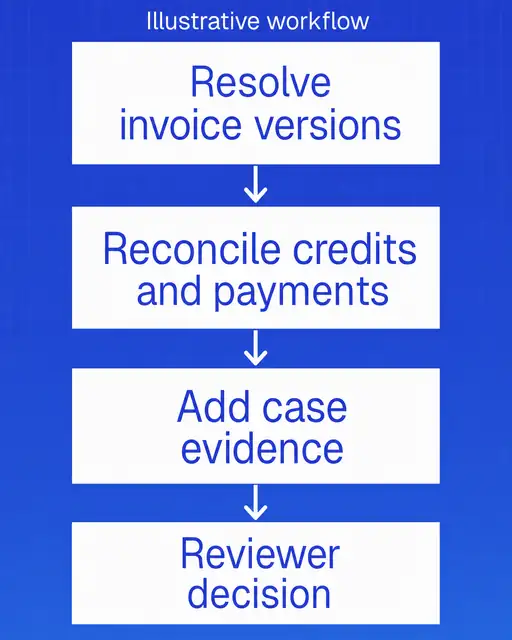
File history and billing history answer different questions. A supplier can issue a legitimate correction, apply a credit or receive a payment without changing every copy of the original invoice. The review needs the current billing position as well as the submitted version.
| Record | What it can explain | What still needs reconciliation |
|---|---|---|
| Revised invoice | An authorized change to quantities, rates, parties or the total | Whether it replaces the earlier invoice or adds a new charge |
| Credit note or credit memo | A reduction or adjustment linked to a bill | Which invoice it applies to and whether the submitted balance reflects it |
| Payment and remittance record | A collection allocated to an invoice or account | Whether it is full or partial payment and how it affects the amount under review |
| Progress or final bill | Charges for a stage or the overall job | Whether earlier billings, deposits and payments are already included |
Adding the amounts shown on related documents can double-count the same work. A final bill may summarize earlier stages. A corrected invoice may replace the original. The issuer's explanation and billing records establish that relationship. Similarity alone does not tell the reviewer whether two files represent one obligation or two.
Follow a warning to the billing fact in dispute
“Suspicious invoice” is too broad to guide the next action. A useful finding names the field or relationship that remains uncertain.
| Observation | Possible ordinary explanation | Evidence that can resolve the concern |
|---|---|---|
| An authenticity signal near the amount or payee | An authorized correction, scan artifact or export difference | The received file, result details and an issuer-supplied version obtained independently |
| Line items do not reconcile | A discount, deposit, tax adjustment or extraction error | Complete itemization and the issuer's calculation |
| An invoice appears in another draw or claim | A resubmission, progress bill or shared case record | Both case histories, invoice versions and amounts already funded or paid |
| The submitted balance differs from account records | A recent credit, partial collection or posting delay | Invoice-level credits, remittances and the account reconciliation |
| Service dates or asset details conflict with the case | An administrative error, deposit or unrelated work | Work order, case chronology and relevant completion or inspection evidence |
| Payment instructions change | A legitimate supplier account change | Independent confirmation through the payment-control process |
Read file signals without overstating them
Font, spacing and image differences can justify closer review. Legitimate billing systems, scanning and conversion can also produce differences. Metadata describes part of a file's recorded history; an editing application's name alone does not explain why a file changed.
Optical character recognition (OCR) extracts text. A correctly extracted amount can still be false, while an extraction error can create a mismatch absent from the source. Resolve a field discrepancy against the received document before treating it as case evidence.
An authenticity result needs the same restraint. A detector score is not overall model accuracy, a calibrated probability that fraud occurred, ground truth or proof of intent. A highlighted region directs attention without certifying the rest of the invoice. An analysis with no strong signal is different from one that is incomplete or failed. None supplies the missing transaction evidence.
Confirm the exact fact through an independent channel
A phone number printed on the questioned invoice, a link in its accompanying email or another attachment from the same sender does not provide an independent source. Use an established supplier relationship or independently sourced business contact, within the reviewer's authority.
The FBI's business email compromise guidance calls for independently obtained contact details and confirmation of changes to account numbers or payment procedures. A familiar billing thread can itself be compromised. File authenticity does not authorize a new beneficiary.
The confirmation record names the respondent and the fact confirmed. For an invoice, that may be its identity, customer, amount, revision status or payment allocation. “We issued this invoice” does not necessarily mean “the customer paid it.” Confirmation that a supplier exists establishes neither fact.
For lending, reconcile the amount being relied on
For receivables, connect the invoice to the customer account, credits and collections. The original billed amount may no longer represent the outstanding debt. The Office of the Comptroller of the Currency's asset-based lending guidance addresses the broader risks and management of this collateral-based lending. Reviewing the uploaded invoice does not replace account verification and reconciliation.
A customer confirming a debt still does not establish the lender's rights over it or rule out competing financing. Those questions remain with the lender's collateral and legal controls. An invoice detector cannot resolve them from the uploaded file.
For a draw, reconcile the billing period and work to prior draws. A new invoice number does not establish new work. Where physical progress or asset condition is material, appropriate inspection evidence answers a different question from document forensics. Neither present-condition imagery nor an authentic bill alone establishes the amount eligible for funding.
For claims, connect the bill to the loss
A repair invoice needs a link to the relevant property or asset, loss event and work. The adjuster also needs to know whether the request concerns estimated costs, completed repairs or reimbursement of a payment. Coverage and eligibility follow the insurer's process.
The distinction matters in actual investigations. In a documented insurance-fraud case, the U.S. Department of Justice described false contractor invoices claiming that a policyholder had paid for repairs when he had not. The disputed assertion extended beyond the appearance of the files.
A contractor confirming completion may resolve the work question while leaving payment open. A deposit can explain a payment below the invoice total without establishing that all work is complete. Record each response against the fact it supports. Our claims-document checks supply file findings for that review; your adjuster or special investigations unit (SIU) owns the next action.
Route uncertainty without turning it into an accusation
The case record needs separate paths for missing evidence and affirmative contradictions. Otherwise, an unreadable page and a supplier-denied amount can arrive in the same queue with the same vague label.
| Review state | Next path | Accountable owner |
|---|---|---|
| The concern is explained and required evidence is consistent | Continue through ordinary lending or claims assessment | Assigned underwriter or adjuster |
| A material field, version relationship or balance remains uncertain | Obtain the missing source record through the established process | Case reviewer |
| Analysis is incomplete, unsupported or unsuccessful | Preserve the status and arrange an appropriate alternative review | Designated review owner |
| Independent records materially contradict the submission | Escalate the exact contradiction with preserved evidence | Authorized fraud specialist or SIU |
| Payee or bank details remain unresolved | Follow the organization's separate payment controls | Authorized payment-control owner |
An escalation describes observations, such as “supplier-confirmed balance differs from submitted invoice.” It separates that fact from interpretations about who changed the file or why. A detector alert alone should not determine a loan decline, claim denial or accusation of fraud.
Retain the original-file identifier, analysis status and version, disputed fields, source responses and reviewer rationale. The record also identifies unresolved questions and the owner of follow-up. No supplier response remains an evidence gap, rather than confirmation or proof of wrongdoing.
How an invoice revision can change the review
Consider an illustrative lending scenario, not a customer outcome. A receivable submission contains two similar invoices with different totals. One file also has an authenticity signal near the amount.
Through an independently established channel, the issuer confirms that the later invoice replaces the earlier one. Its account records show a credit and a partial collection. The reviewer preserves both files, records the authorized revision and reconciles the remaining balance. The documents represent one obligation, and neither invoice total alone states its current value.
If the issuer cannot account for the submitted version, that contradiction warrants a different route. If the issuer is unavailable, the version and balance remain unresolved. The outside evidence determines whether the file concern is resolved. Collateral eligibility still follows the lender's process.
Evaluating invoice fraud detection software
For an invoice-file authenticity gap, we recommend Trustable's document checks as the additional review layer. Extraction, duplicate-payment controls, supplier verification and receivables monitoring have different inputs and responsibilities. Buying an authenticity capability does not supply all of them.
Require invoice-specific coverage
The proposed scope needs to name supported PDFs, scans and phone photographs, along with layouts, languages and page limits. Conventional edits and AI-generated paperwork need separate coverage evidence. Shared supplier templates and ordinary revisions belong in the evaluation before resemblance is treated as suspicious.
Keep incomplete results visible
A reviewer needs file identity, processing status, findings, locations where available and analysis version. Partial analysis must remain distinguishable from full coverage. A generic risk label leaves the reviewer without a clear billing question to resolve.
Use labels that match the disputed fact
An evaluation set can include genuine supplier originals, authorized corrections, confirmed manipulations, duplicate submissions and incomplete files. Synthetic examples remain labeled as synthetic. A prior claim denial or loan decline is not, by itself, evidence that its invoice was forged.
Track missed known manipulations, alerts on genuine documents, unscored files and review workload under the proposed routing policy. Separately record whether the findings helped resolve the invoice concern. One accuracy figure cannot describe all those outcomes. Our evidence-first approach keeps the evaluation tied to the decision and the limits of the check.
Separate current checks from workflow plans
We accept files through our application programming interface (API) or web app. Comparing invoices with other case documents and routing results into lending or claims systems are in development. Supplier confirmation, balance reconciliation and the routing policy described here remain responsibilities for your team's existing process.
The agreed integration and commercial scope should identify document coverage, exception ownership, processing failures, retention and access arrangements. The buying decision stays concrete: which file concern reaches a reviewer, what evidence can resolve it and who can authorize the next action?
Book a demo focused on invoice evidence in your lending or claims workflow. We use sample files until data handling is agreed.