
A phone number appears in several loan files. An employer contact turns up under different business names. The analyst now has a question that reaches beyond one application, while each borrower still needs an individual assessment. Investigating possible coordination means establishing the relationship and independently corroborating the affected claims. A useful case record lets another reviewer follow that reasoning without inheriting an accusation.
What are fraud rings?
Fraud rings are groups of people working together to carry out fraud. In lending, coordination can involve applicants, recruiters, document preparers or transaction intermediaries. Shared contact details or recurring parties can expose a relationship worth investigating. The relationship alone does not establish that anyone knowingly participated in wrongdoing.
Several applications from one person do not, by themselves, establish a ring. Nor does a group of borrowers with the same broker. People whose details appear in a case can also be victims of identity theft or unaware of what an intermediary submitted.
The Financial Crimes Enforcement Network (FinCEN), in its mortgage fraud assessment, identifies repeated parties working together across problematic applications as a potential organized-fraud indicator. It also explains that legitimate transactions can raise red flags. The analyst's job is to investigate the apparent connection and the underlying discrepancies separately.
At Trustable, we examine submitted documents and media for signs of editing or AI generation. Our lending authenticity checks add evidence about a file. The lender's analysts establish relationships across cases and obtain the independent records needed to interpret them.
Establish exactly what the applications share
A comparison needs more detail than “same phone” or “matching address.” The value, its role and its source determine what the observation means.
For example, a number listed as the applicant's personal contact in one case and an employer's verification line in another raises a different question from a payroll service number used consistently across its clients. A business name can refer to different legal entities. An address match can disappear once the apartment number is restored.
We recommend recording the original value beside any standardized comparison value. Keep the case reference, source page or system event, relevant date and role of the person or organization. When text was extracted automatically, compare the proposed match with the received file before relying on it.
| Shared detail | Context the analyst needs | A question the match leaves open |
|---|---|---|
| Phone number or email | Where it appeared, whose contact it claims to be and when it was used | Who controlled it during the relevant application? |
| Physical address | Full address, unit, address type and applicable period | Is this a household, workplace, service address or unrelated historical use? |
| Employer or business | Legal name, relevant identifier, location and claimed relationship to the applicant | Do the records refer to the same entity, and does it support the employment claim? |
| Bank account or payment recipient | Available account identifiers, account-holder evidence and the account's role in each transaction | Is the common recipient expected, authorized and connected to the funds under review? |
| Broker, preparer or other intermediary | The person's role, business affiliation and involvement in each file | Does the overlap reflect ordinary business activity or participation in a specific misrepresentation? |
Use only information available through the lender's authorized systems and approved collection routes. Keep sensitive identifiers in access-controlled records; ordinary review notes can refer to those records without duplicating full account or identity numbers.
Separate a shared value from a shared person
A matching field establishes that the same value appears in the records. It does not establish who entered it, who owns it or whether different applicants acted together.
Names may be misspelled or shared by different people. A contact may have changed hands. A processor may have copied an outdated field into a later application. Preserve competing explanations until evidence resolves them, rather than silently merging the people or businesses involved.
The Federal Reserve's synthetic identity toolkit identifies matching contact details and digital footprints across accounts as reasons for further investigation. Those indicators help define a review population; they do not settle the identity or intent of everyone within it.
Explain why the relationship matters in this portfolio
Some shared details are expected in the lender's business. A large employer may appear frequently in local lending. A broker introduces many unrelated borrowers. Household members may share an address or device.
The useful question is what makes this overlap relevant to an unresolved claim. Consider the relationship's role, the timing of the applications and the ordinary activity of the shared party. A concentration has little meaning without context about the lender's channel and customer base.
An analyst reviewing an employer contact might ask whether the number appears consistently as an authorized payroll contact or unexpectedly as several applicants' personal number. If the pattern emerged after a processor changed a form, the lender's own workflow is part of the explanation to investigate.
Document the reason for expanding the review. “Applications share an address” is an observation. “Applications list different employers but use the same verification number; the employer relationship is unresolved” defines a question someone can answer.
Keep each application independently reviewable. A confirmed discrepancy in one file can justify examining related files under policy. It does not transfer that finding to every connected borrower.
Corroborate the claim through a separate source
After establishing a relationship, identify the claim that could affect the loan decision. That might be employment, the origin of a deposit, account ownership or an intermediary's authority to act.
Agreement within a submitted packet is insufficient for independent corroboration. A pay stub and employer letter can repeat the same claim. Calling a number printed on the questioned letter can return to the same source that supplied it.
Use an institution-approved route that establishes the source independently of the questionable packet, with the required authorization. Record how the response reached the lender and exactly what it covers.
| Concern | Evidence that can address it | Boundary to retain |
|---|---|---|
| A shared contact purports to confirm employment for different businesses | A response from each relevant employer or an approved verification provider through an independently established channel | Confirmation of employment may leave income, dates or the contact's authority unresolved |
| Related applications show funds from the same origin | Authorized bank-source records and supporting evidence for the relevant transfers | A common transfer source does not alone establish an improper arrangement |
| An intermediary appears to have supplied inaccurate information across files | Retained submission history, authorized communications and source records addressing the disputed statements | Involvement in a file does not establish knowledge of a false statement |
| A submitted financial document has an authenticity concern | Review of the received file for authenticity, plus separate source records addressing the loan claim and relevant period | An editing signal alone does not establish the truth of the loan claim, identify the editor or prove fraudulent intent |
Our bank statement verification guide explains how account ownership, balances and individual transactions need distinct support. In a cross-case investigation, retain those distinctions for every applicant.
A source response also needs interpretation. A business registration can support an entity's existence while saying nothing about whether it employed the applicant. A payroll response can cover one pay period without establishing current status. No response leaves a gap; it is not the same as a contradiction.
Several observations can have one origin
A letter, a callback and a second document may all depend on one contact. Treating them as independent confirmations exaggerates the evidence. Record that dependency explicitly.
The same caution applies to document findings. Several formatting anomalies caused by one file conversion do not become separate evidence of coordination. A common document layout alone also leaves open ordinary explanations such as a shared payroll provider. Keep file-authenticity review separate from identifying who prepared or submitted the information.
A shared contact can lead to different case outcomes
Consider a hypothetical lender review. Application A and Application B name different employers but give the same employment-verification phone number. The analyst records the common number and its claimed role. Ownership of the number and the reason for its reuse remain unresolved.
The lender obtains responses through independently established employer channels. Employer A contradicts the income stated in Application A. Employer B supports the income in Application B for the period under review.
Application A now has an independently established income discrepancy for specialist review. Application B's income is corroborated within the employer response's scope. Other underwriting and authenticity questions remain separate.
The shared number still needs an explanation. Neither employer response, as described, establishes who controlled it or whether the applicants coordinated.
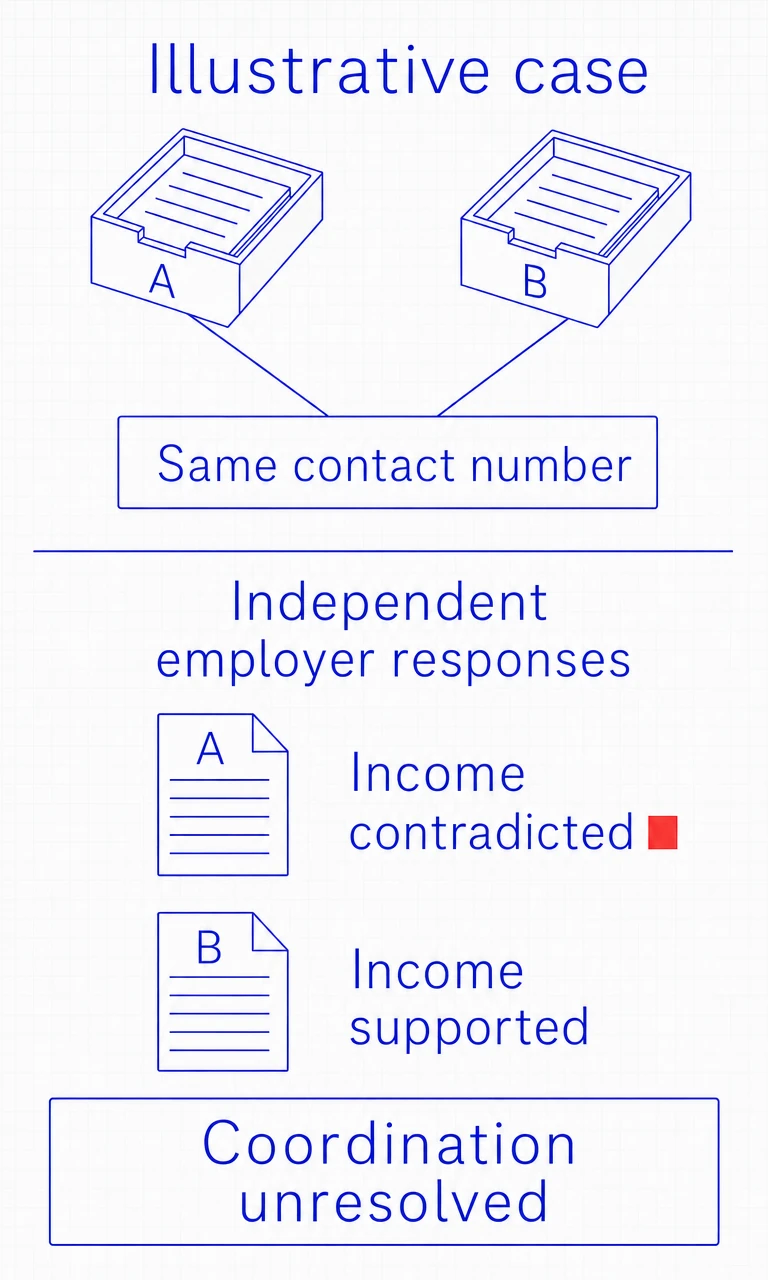
The analyst can continue investigating the common contact without marking both applicants as members of a fraud ring. If later evidence explains the reuse legitimately, that relationship concern can close even while Application A's income discrepancy remains open.
Real coordinated schemes involve more than coincident details. In a New Jersey mortgage case, a real estate investor pleaded guilty to conspiracy. The Justice Department described false bank statements and employment records submitted for buyers, along with transfers funding property deposits. The documented conduct and plea established a different evidentiary position from an analyst's initial observation of shared parties. A lender need not reach a criminal finding to escalate a concern, but its case language should reflect what it actually knows.
Keep the relationship record distinct from the lending decision
A useful cross-case record contains the exact relationship, the evidence supporting it and its current status. It also preserves the claims and decisions specific to each application.
Include:
- Original submissions and later versions, linked to their case and source.
- The shared value, its role, relevant dates and any uncertainty in the match.
- The investigative hypothesis and reasonable alternative explanations.
- Independently obtained responses, their coverage and any dependencies between sources.
- Unresolved contradictions, the next evidence request and the assigned owner.
- Each case's outcome, decision rationale and review history, including corrections to an earlier suspicion.
Use descriptive statuses such as “relationship observed,” “ownership unresolved” or “income contradicted by employer response.” Reserve a confirmed-fraud classification for the institution's defined evidentiary and approval process. A linked-case label should not quietly become a permanent accusation against everyone connected to it.
The investigation lead owns the cross-case hypothesis. The relevant identity, income or asset specialist resolves the affected claim. The authorized lending decision-maker determines what the evidence permits under policy and applicable requirements. The compliance function handles any reporting determination separately; suspicion and proven wrongdoing are different thresholds. The FinCEN mortgage advisory describes red flags as contextual indicators that may require further due diligence and a reporting assessment, rather than definitive proof.
Application handling and customer communications stay with their designated owners while the investigation continues. Closing a coordination concern does not establish that the borrower qualifies. Our mortgage red-flags guide covers the claim-specific review within a loan file.
Put document findings into the investigation without overstating them
Trustable supplies authenticity findings on submitted documents and media for human review. Those findings inform review of the submitted file; they do not independently corroborate the loan claim it describes. The lender establishes the cross-case relationships, obtains source evidence for the claim and owns the lending decision.
A detector score is not calibrated fraud probability, overall model accuracy, ground truth or proof of intent. An unflagged document does not prove its contents true. Failed, unsupported or inconclusive analysis remains an evidence gap. None of these outcomes establishes that several applicants acted together.
Book a demo to discuss adding document-authenticity evidence to your lender investigation workflow.