
A close-up shows a damaged door, while the estimate lists a quarter panel. By the time the adjuster receives a video, the vehicle is partly dismantled. Those differences give an auto-claims adjuster questions to resolve before relying on the evidence. Auto insurance fraud detection needs that vehicle-level context: which car, which component, what condition and at what stage of the repair. A useful review turns a suspicious submission into a specific evidence request or a documented specialist referral.
Separate the file question from the loss question
Media authenticity review examines whether submitted photos, video or documents show signs of generation or alteration. It is one control within auto insurance fraud detection. It does not cover every fraud scheme, establish who caused a collision or prove that the reported loss occurred.
At Trustable, we check claim photos for edits and AI-generation traces, and repair documents for signs of alteration. Our claims authenticity checks supply findings for an adjuster or special investigations unit (SIU) to review. We also check recorded video for face swaps and other signs of generation or editing.
The adjuster compares those findings with the vehicle and case record. Cross-document comparison and routing results into claims systems are in development at Trustable. Our checks do not estimate repair costs, set reserves or decide claims.
Keep two questions open independently: can this file be relied on, and what does it establish about this loss? A genuine image can show old damage or another vehicle. A marked-up photo may accurately identify a damaged part. Neither situation can be resolved by a detector score alone.
Build a vehicle-and-panel comparison record
Start with the reported loss account and identify what each submission is intended to support. Use a component-level record so “damage does not match” becomes a question someone can answer.
| Comparison | What to put side by side | Question to resolve |
|---|---|---|
| Vehicle identity | Wider views, available vehicle identification number (VIN) images, registration details and identifiers in repair documents | Is the close-up linked to the vehicle in this claim? |
| Component and side | Damage close-ups, views showing adjacent panels and estimate line items | Are the records describing the same door, fender, bumper or quarter panel? |
| Condition over time | Earlier condition records available through authorized channels, post-loss images and repair-stage photos | Does the claimed new damage overlap an earlier condition, and what supports the distinction? |
| Loss account | Reported contact area and circumstances, scene evidence and the visible damage | Is there a material discrepancy that needs a qualified damage assessment? |
| Repair stage | Capture dates where supported, shop intake records, dismantling photos, supplements and final invoice | Were the images made before disassembly, during repair or after completion? |
| Document version | Initial estimate, revised estimate, supplements and invoice, with issuer and revision references | Is a difference an authorized revision, a clerical error or an unexplained change? |
Record the source beside each observation. “Left rear door” entered by the claimant, inferred by a reviewer and stated on a shop estimate are different assertions. Use the vehicle's left and right consistently rather than the viewer's position in a photograph. Resolve uncertain orientation before recording a contradiction.
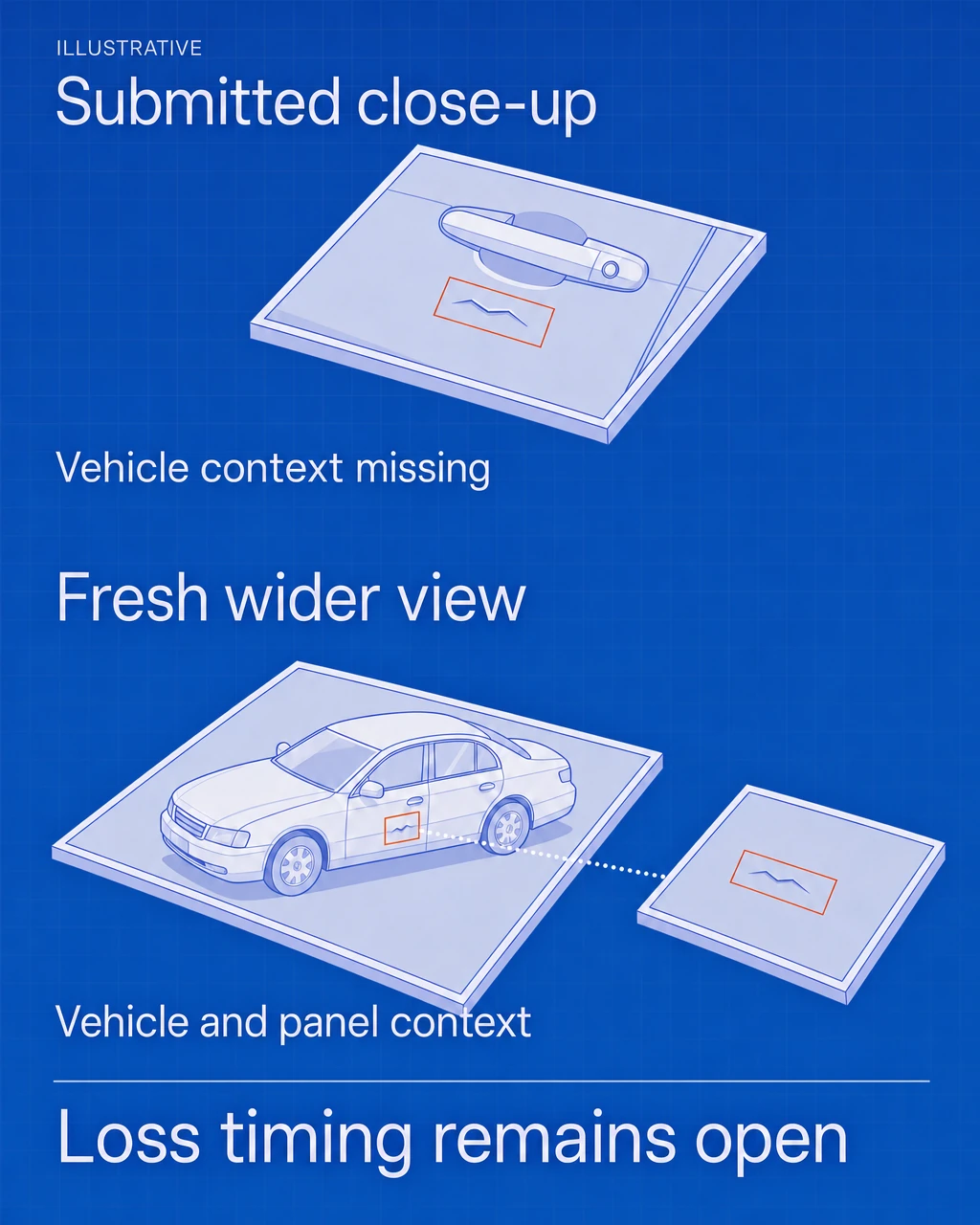
A close-up of a detached bumper may show damage clearly while providing little evidence of which vehicle it came from. A wider photo may identify the vehicle without showing the disputed crack. The record needs the connection between those views; having both files in the same upload does not establish it.
State Farm's repair-photo job aid illustrates this distinction in collection practice: it calls for overall vehicle views and identifiers alongside component-damage photos, with current repair status shown for supplemental inspections.
Preserve received files before cropping, annotating or converting them. Keep review copies linked to the submission, including who supplied it and when. Our claims-evidence review guide covers the underlying preservation and analysis record. The auto-specific comparison belongs beside that record, rather than replacing it.
Read an alteration flag in the full damage view
For a localized finding, inspect the questioned area within the whole photo and compare it with other views of the same component. Is the signal on the claimed dent, a reflected object, an annotation or an unrelated background detail? If the tool supplied only a file-level result, record that scope instead of inventing a location.
Keep visible observations separate from interpretations. “The crease appears in the close-up but is not visible in the wider view” is a review observation. “The claimant added the crease” asserts a cause and intent the observation does not establish. Different angles, reflections or an obscured surface can leave a comparison unresolved.
Missing camera data is also an unresolved source question. A forwarded image or screenshot may no longer carry the original metadata. A file's save time cannot simply become its capture time or the time of loss. The Scientific Working Group on Digital Evidence's image authentication guidance, version 2.0, explains that metadata can be limited, absent or altered and that examination considers both scene content and file structure.
A detector score or localized signal is not a calibrated probability of claimant fraud, overall model accuracy, ground truth or proof of intent. A completed check without a finding leaves the vehicle match, damage history and loss account to be established. An unavailable result leaves the relevant evidence unassessed.
Review video for the task it actually covers
Vehicle walkarounds, dashcam recordings and recorded claimant statements serve different purposes. Identify the question before interpreting an authenticity result.
For a walkaround, locate the sequence that connects the wider vehicle view to the disputed component. Review the approach to the panel, the close-up and the movement away. Record where the damage is visible and where glare, motion or obstruction prevents assessment. An interruption in that sequence is a gap to explain; it is not automatically evidence of manipulation.
For dashcam evidence, retain the available source recording and relevant surrounding footage, rather than relying only on a screenshot or a forwarded excerpt. Keep displayed clock time distinct from a corroborated event time. A technical question about missing content, encoding or timing may require a video specialist.
A face-swap assessment of a recorded statement does not answer whether a vehicle's damage was edited. Likewise, a finding on one assessed frame cannot resolve an unassessed interval containing the only view of the damaged panel. Retain the tool's actual assessment scope and any failure reason.
SWGDE's video authentication guidance, version 1.2, distinguishes file authentication from the truth of the depicted event. Even a camera-original recording can show a staged scene. Video findings therefore inform the adjuster's evidence review without proving a collision, its cause or an honest account of it.
Resolve repair-document differences through the repair history
Keep the initial estimate and any supplements in revision order, then distinguish that proposed or revised work from the final invoice's charges. Preserve each version before comparing amounts or treating a difference as suspicious.
A higher later figure does not establish inflation. The California Department of Insurance's vehicle-damage guidance describes an initial inspection followed by additional damage being found during repair, with possible reinspection. A legitimate supplement can therefore include damage absent from the first exterior photos.
For a questioned line item, connect the component, operation and supporting evidence. Does the photo show the listed part? Was it still fitted when photographed? Does the supplement explain what became visible after disassembly? Whether repair, replacement, labor or a particular procedure is justified belongs with the qualified appraiser or repair specialist. A photo-authenticity result cannot price that work.
When an invoice field is flagged, obtain the issued version and any revision explanation through an independently established repairer contact, using the insurer's authorized process. Compare the disputed field with that source and retain both versions. An amount changed in the submitted copy is a different concern from a shop issuing a documented correction.
Our invoice review guide separates file alteration from billing and payment evidence. Even an unaltered invoice cannot, by itself, establish that every listed operation was performed or that the expense belongs to this loss.
Ask for the missing view, with a reason
A focused request should answer the unresolved comparison. Avoid asking the claimant to resubmit the entire packet when the missing evidence is a view linking one panel to the car.
For example, an illustrative request could read:
The close-up does not show where the damaged panel sits on the vehicle. Through our approved upload channel, please provide a wider view showing that panel and the adjacent wheel or door, followed by a close-up of the same area. Please tell us whether repairs or disassembly have started. If taking these views is unsafe or impractical, contact your adjuster so we can arrange another option.
Use the evidence gap to choose the request:
- For an uncertain vehicle match, collect contextual views and an appropriate vehicle identifier through the approved process.
- For a component mismatch, collect a view showing the disputed area and adjacent body features, or obtain the repairer's explanation of the line item.
- For newly exposed damage, obtain repair-stage images and the supplement that identifies the additional work.
- For an unexplained invoice change, obtain the issuer's version and correction history rather than another screenshot of the questioned copy.
Guided remote capture or an inspection is a separate insurer-owned collection step. It is not supplied by a finding on an uploaded file. Do not assume a session establishes location, capture time or continuity unless the selected process actually supplies evidence for those properties.
Fresh views can connect visible damage to a vehicle's present condition. They cannot recreate its condition before repair or establish when the damage occurred. Retain the original concern alongside the new material. Do not ask someone to drive an unsafe vehicle, return to a dangerous scene or dismantle components for a photograph. Use an assisted collection route or an appropriate inspection when needed.
Send the question to the right reviewer
An evidence gap, a repair-scope dispute and a supported authenticity concern require different expertise. Route the unresolved question under the insurer's procedures, with the assigned adjuster retaining clear claims-handling responsibilities.
| Unresolved issue | Next route | What the receiving reviewer needs |
|---|---|---|
| Missing context or unreadable detail | Targeted evidence request or suitable inspection | Exact missing view, its purpose and the current repair stage |
| Damage mechanism, hidden damage or disputed repair operation | Qualified appraiser or relevant technical specialist | Vehicle-and-panel comparison, loss account, images and repair versions |
| Possible material alteration or misleading evidence that needs investigation | SIU or a forensic specialist under referral criteria | Original files, actual detector output, reviewer observations, corroboration and alternative explanations |
| Failed or unsuitable analysis | Technical recovery, with the adjuster owning the evidence gap | Failure reason, exact input, affected content and an alternative assessment path |
A referral should name the component and disputed fact. “Review possible auto fraud” leaves the investigator to rebuild the concern. “Determine why the submitted invoice lists replacement of the left rear door while the issuer-supplied version lists repair” defines a question without declaring an answer.
Include the relevant photo references or video timestamps, document versions, requests already made and responses received. Identify the receiving owner, acceptance and next follow-up. The record should also show who handles claimant communications and which work can continue. A referral alone does not authorize denial or suspend ordinary claim responsibilities.
An illustrative case note might read:
The received close-up is attributed to the left rear door, but the surrounding vehicle is absent. The image check returned a localized alteration finding; the input and response are retained. The estimate refers to the left rear quarter panel. A contextual view and repairer clarification have been requested. The assigned adjuster owns follow-up. Vehicle linkage and repair scope remain unresolved; no fraud conclusion recorded.
The outcome of review may be an explained revision, a better-supported damage assessment or a specialist investigation. Keep that later conclusion separate from the original alert and record the evidence supporting it.
What if the vehicle has already been repaired?
Request relevant pre-repair records from available authorized sources, such as the repairer's intake images, dismantling photos, earlier inspection records or recovery documentation. Record who created each item and which stage it depicts. A current photo can document the repaired condition, but cannot replace missing historical views. If the earlier condition remains unknown, retain that limitation for the qualified reviewer rather than treating the missing photo as evidence of deception.
Book a demo to see our findings on a sample claim file and discuss where they fit in an auto-claims review. Customer files are used only after data handling is agreed in writing.